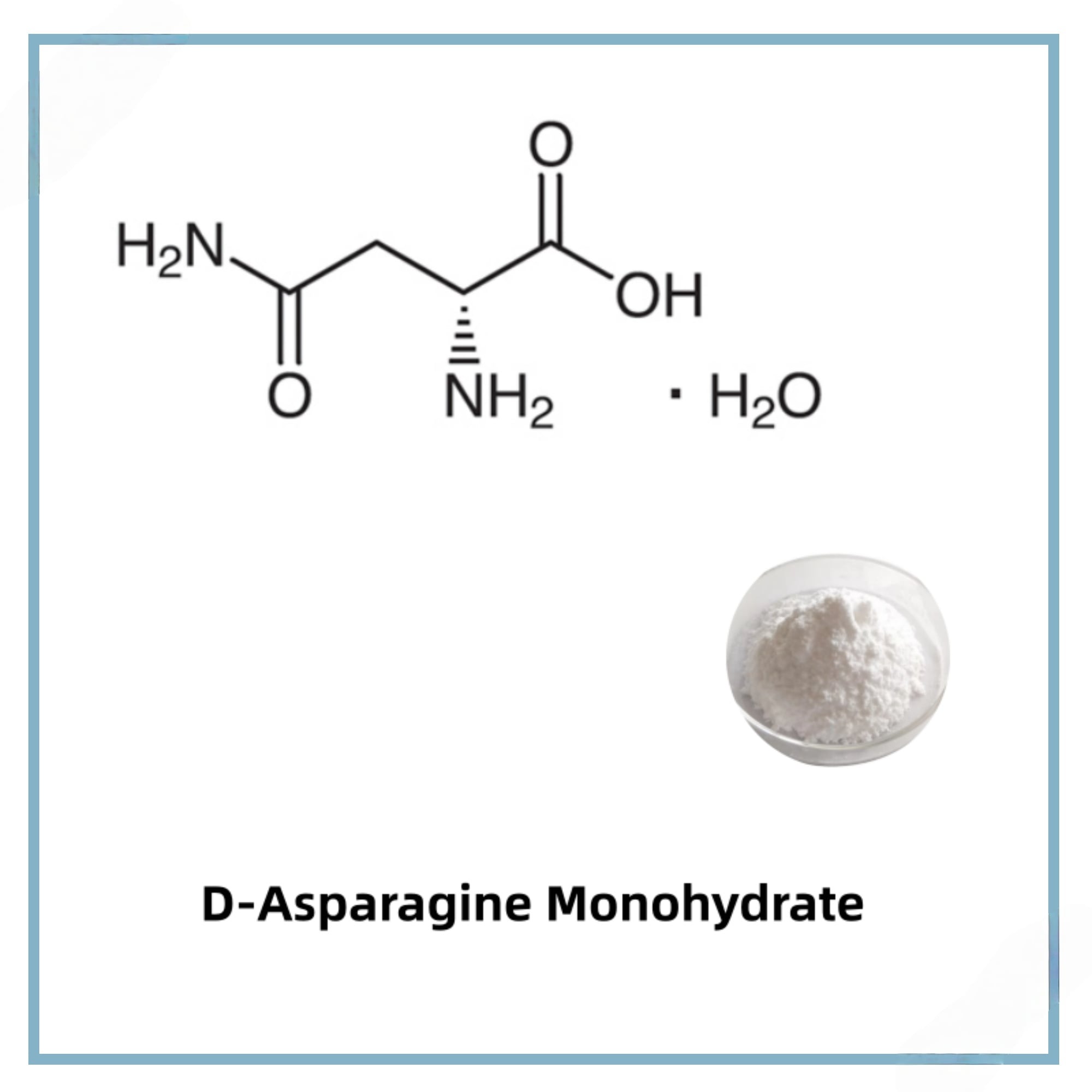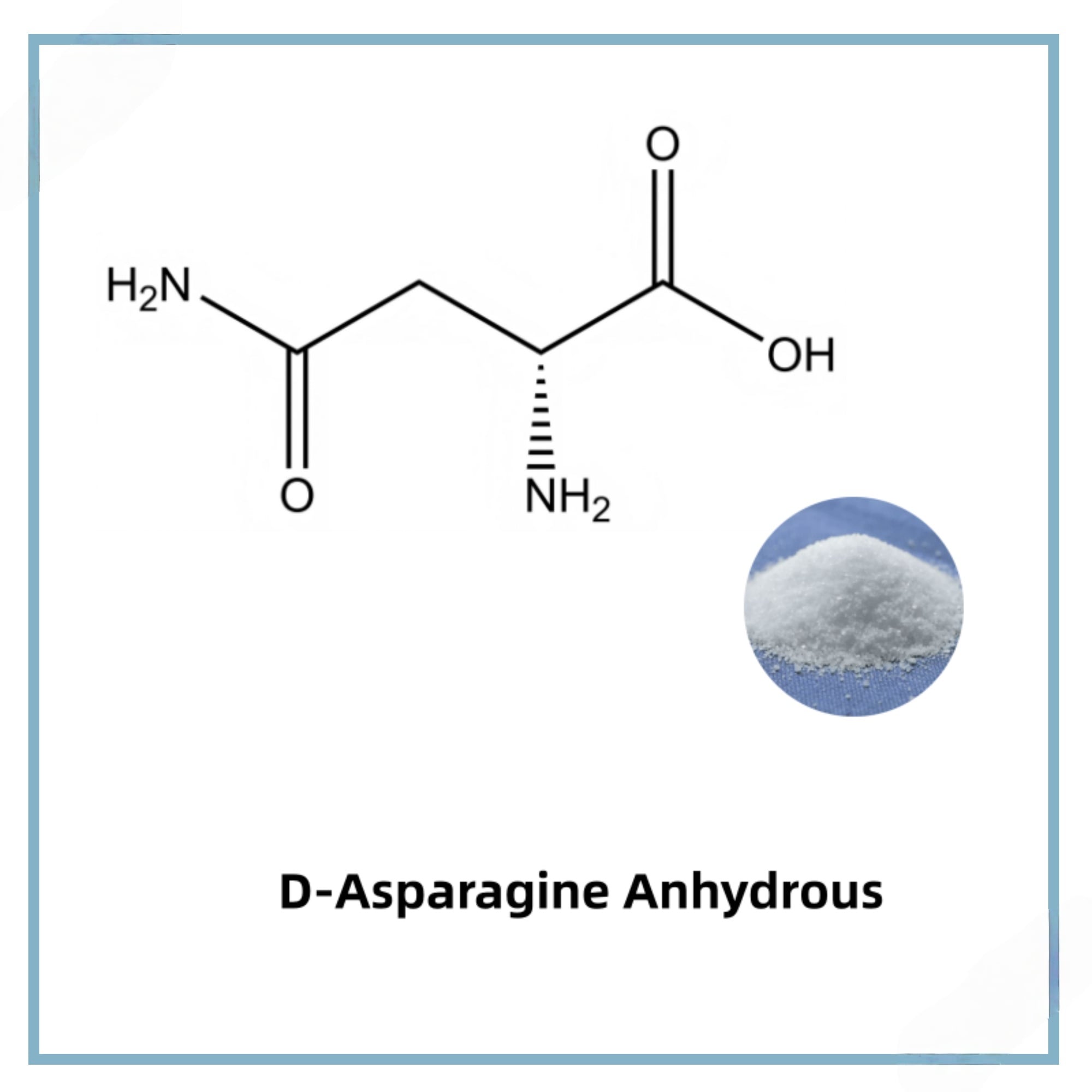
| Product Name | D-Asparagine Anhydrous |
| Other Name | D-Asn-OH; (R)-2-Aminosuccinic acid 4-amide; D-2-Aminosuccinamic acid |
| CAS No. | 2058-58-4 |
| EINECS No. | 218-163-3 |
| Molecular Formula | C₄H₈N₂O₃ |
| Molecular Weight | 132.12 |
| Appearance | White crystalline powder |
| Packing |
1kg/5kg Aluminum foil bag 25kg/Drum 25kg/Carton or as per customer's requirement |
| Storage | Store in a cool, dry place, tightly sealed, away from heat and light |
| MOQ | 1 KG |
| Payment | T/T, LC or DA |
| Delivery Time | Ready Stock in Local Warehouse, 1-3 days |
| Origin | China |
| Shipping | DHL, FedEx, TNT, EMS, By Sea, By Air |
D-Asparagine is a chiral isomer of asparagine, whereas D-Asparagine Anhydrous is a pure form of D-Asparagine through stripping water of crystallization and the specific dehydration process.
1.It is used to synthesize the advanced chiral pharmaceuticals. The majority of proteases in the human body can only identify and degrade L-amino acids, so if you apply peptide drugs by the synthesis of D-Asparagine, they will evade enzymatic breakdown and remain in the bloodstream for a longer time, thus significantly enhancing their therapeutic efficacy.
2.Traditional skincare peptides (L-configuration) applied to the skin are rapidly degraded by microorganisms or enzymes. When D-aspartamide is integrated into materials, this peptide becomes exceptionally powerful and resilient, delivering continuous restorative and anti-ageing benefits. Therefore, it is called a powerful solution to the problem of skincare products being high activity and low substantivity.
3.D-Asparagine Anhydrous ensures that the moisture could be control to≤0.5% during sensitive amidation reactions and chiral catalysis to avoid metal catalyst deactivation.
1.Shandong Fulibai Chem Co., Ltd. uses low-temperature vacuum drying technology to maintain the stability of chiral configuration. Besides, the value of enantiomeric excess (ee) always remains≥99.5%, so the quality of synthetic peptide products is guaranteed at the source.
2.We adhere to the anhydrous grade specification that requires moisture to be controlled at≤0.5%, which is crucial for amidation reactions and anhydrous system for organometallic catalysis, effectively preventing catalyst deactivation and the generation of side reactions.
3.Based on research and development (R&D) into challenges, we will provide precision sealed packaging for 1kg and 5kg that uses nitrogen-filled, three-layer aluminum foil vacuum sealed packaging.
4.Regarding D-Asparagine Anhydrous, we not only provide a certificate of analysis (COA), but also provide specific optical rotation measurement spectrum, high performance liquid chromatography (HPLC) and loss on drying curve (LOD).
Q1: Why does use D-Asparagine in peptide synthesis?
A: Because of its protease resistance. Natural protein is made of L-amino acids that are degraded by protease in the human body. Then, by using D-Asparagine Anhydrous, the conformation of peptide molecules will be changed, resulting in it not being recognized by the protease recognition system, which significantly extends the drug half-life in the human body and maintains the drug persistence and stability.
Q2: What is the specific significance of the anhydrous grade specification in chiral synthesis?
A: Numerous advanced chiral reactions (such as amide coupling reactions and metal-catalyzed reactions and so on) are extremely sensitivity to moisture. The 12% water of crystallization contained in the monohydrate will be degraded in the process of reaction, which leads to the deactivation of costly catalysts or hydrolysis side reactions. Our anhydrous grade products maintain moisture within the range of ≤ 0.5%, providing a pure starting of “zero moisture interference” for your precision synthesis.
Q3: How do you prevent racemisation during the dehydration treatment process?
A: This is a crucial technology. D-configurational is easily converted to D-configurational under the condition of high-temperature dewatering, resulting in a reduction in chiral purity. Therefore, Shandong Fulibai Chem Co., Ltd. applies the low-temperature vacuum drying technology, which we guarantee will keep the specific rotation of each batch stable between–34.2°and–36.5, ensuring you receive an enantiomer of the highest purity while eliminating moisture molecules without compromising the chiral structure.
Q4: Why does D-Asparagine Anhydrous have a higher potency?
A: Because of the difference in molecular weight. Anhydride’s molecular weight is 132.12, but monohydrate’s molecular weight is 150.13, which means that the active asparagine molecular is contained in anhydride is approximately 13.6% higher than in the monohydrate. Therefore, given that experiments require accurate control the molar concentration, anhydride offers a higher effective load and more precise dosing control.
Q5: How can the product be kept anhydrous and retain its chiral activity after opening?
A: D-Asparagine Anhydrous has strong hygroscopicity. We will use the three-layer vacuum aluminum foil bag nitrogen-filled packaging upon factory deliver. It is recommended that clients open the package in a drying oven or a glove box and obey strictly the principle of ready-to-use. If the product cannot be used in one instance, the air must be removed promptly and the container sealed, storing in a dry, protect from light place at a temperature below 20。C to prevent it from absorbing moisture and reverting to the monohydrate, or from undergoing physical deterioration.
Shandong Fulibai specializes in providing high-quality raw materials for the nutritional and cosmetic industries.
Floor 13, Block 1, No. 6888, Jiankang East Street, Weifang High-tech Zone, Shandong Province, China.
Copyright © 2026 SHANDONG FULIBAI CHEM CO.,LIMITED. All rights reserved. Privacy Policy
 EN
EN