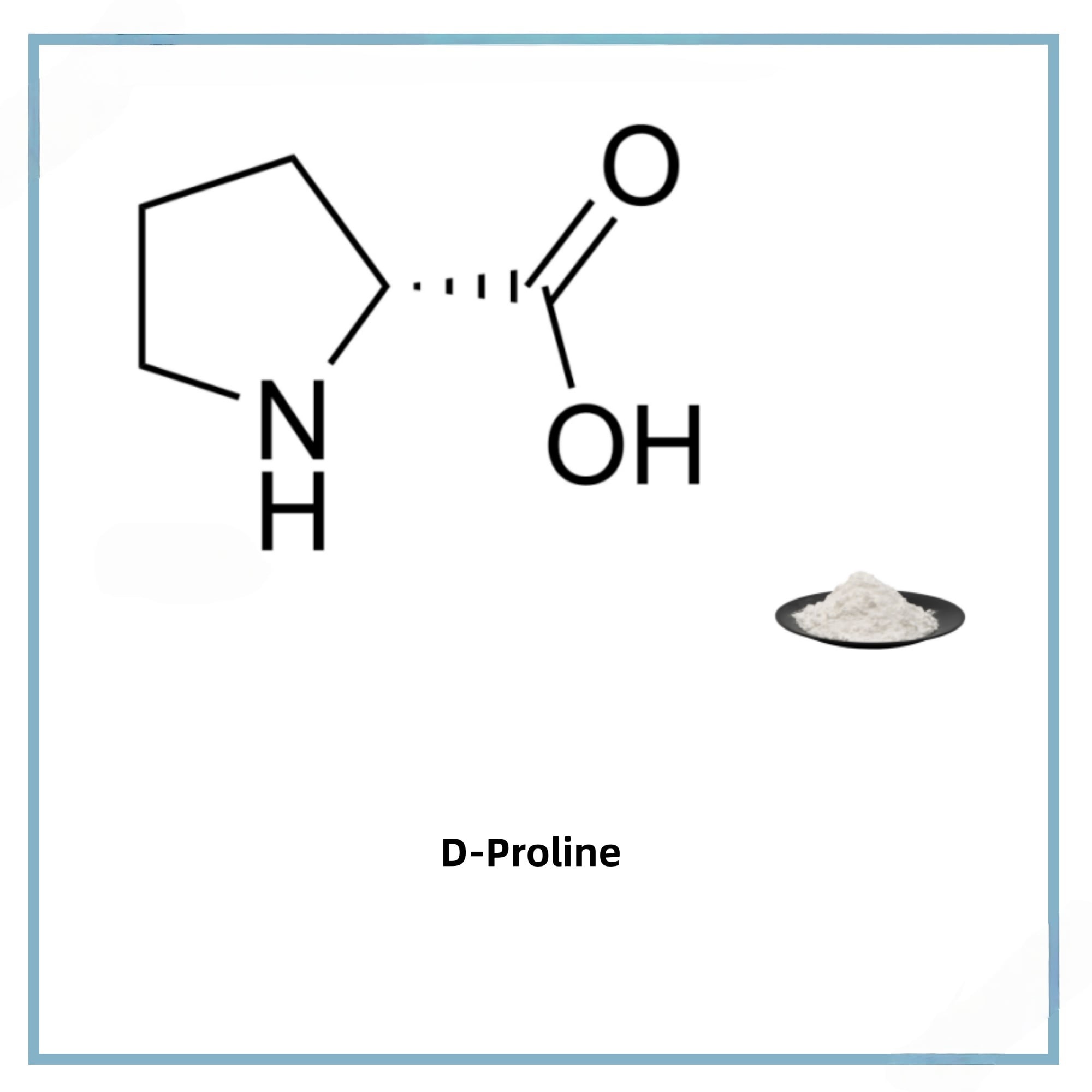
| Product Name | D-Proline |
| Other Name | D-Pyrrolidine-2-carboxylic acid |
| CAS No. | 344-25-2 |
| EINECS No. | 206-452-7 |
| Molecular Formula | C₅H₉NO₂ |
| Appearance | White crystals or crystalline powder |
| Packing | 1kg/5kg Aluminum foil bag 25kg/Drum 25kg/Carton or as per customer's requirement |
| Storage | Store in a cool, dry place, tightly sealed, away from heat and light |
| MOQ | 1KG |
| Payment | T/T, LC or DA |
| Delivery Time | Ready Stock in Local Warehouse, 1-3 days |
| Origin | China |
| Shipping | DHL, FedEx, TNT, EMS, By Sea, By Air |
D-Proline is an artificial chiral isomer of proline (L-Proline is the most common form in nature), which is easily soluble in water and exhibits a white or white crystalline powder. What’s more, D-Proline as a chiral building block is an indispensable raw material for the synthesis of complex drugs and high performance materials.
1.D-proline is mainly applied in the synthesis pharmaceutical industry. Because a larger of drugs require a specific spatial structure (chiral) to be effective and minimize side effects, it’s usually used as a synthesis of precursor or intermediate in chiral drugs.
Anticholinergic drugs: Synthesis of chiral drugs with specific bioactivity.
Antiviral drugs: D-proline as a chiral frameworks is applied in the complex antiviral molecular structures.
Cardiovascular medications: They are used to produce special chiral derivatives within the Angiotensin Converting Enzyme (ACE) inhibitor categories.
2.D-proline and its derivatives, as an excellent organic small molecule catalysis is used for chiral catalysis in the organic synthesis.
Asymmetric reaction: D-proline can develop specific chiral molecules by effectively controlling the specific spatial structures of production in the carbon-carbon bond forming reactions such as Aldol condensation, Michael addition reaction and Mannich reaction and so on.
Chiral ligand: D-proline as a ligand is used in the asymmetric reaction of organometallic catalytic to increase the selectivity of the reaction.
3.D-proline is a kind of raw materials of dietary supplements and health products, and D-proline and its derivatives are also demonstrating potential in the field of nutrition with the deepening of research into the premium nutrients.
Special nutrition facts: Although L-proline plays an important role in the process of protein synthesis, D-proline is considered to have potential value in the areas of metabolic regulation and neuroscience research.
Food additives: The kind of amino acids used in the premium food additives to enhance specific flavors or as functional ingredients.
4.In the luxury cosmetics sector, D-proline is often converted into derivatives that are more easily absorbed by the skin.
Skin repair: D-proline and its derivatives are the key components in the process of collagen protein synthesis. Besides, D-proline can be used to investigate its role in repairing the skin barrier.
Hydrating and anti-aging:D-proline can improve the hydration sealing to keep skin plump, which used in the anti-aging products as a bioactive additive.
5.In the areas of plant protection and agriculture, D-proline has a number of potential applications.
Chiral pesticides: D-proline is used to synthesize a new, high bioactivity and eco-friendly insecticides or bactericides.
Plant growth regulator: The research indicates that the amino acid isomers at specific concentrations have a certain regulatory effect on plant stress tolerance (e.g. drought resistance and cold resistance).tive and provides a amount of energies and material basis to help cells grow and divide rapidly, as a result, extending the growth cycles of hair, reducing hair loss and promoting new growth.
| Test Item | Inspection Standard | Results |
|---|---|---|
| Appearance | White crystals or crystalline powder | Conforms |
| Specific rotation [α]β | +83.5°~+86.5° | +85.1° |
| Chloride (Cl) | ≤0.020% | ≤0.020% |
| Ammonium (NH4) | ≤0.02% | ≤0.02% |
| Sulfate (SO4) | ≤0.020% | ≤0.020% |
| Heavy metals (Pb) | ≤10 ppm | ≤10 ppm |
| Arsenic (As2O3) | ≤2 ppm | ≤2 ppm |
| Other amino acids | ≤0.5% | ≤0.5% |
| Loss on drying | ≤0.5% | ≤0.5% |
| Residue on ignition | ≤0.3% | ≤0.3% |
| Assay | 98.5%~101.0% | 98.7% |
| pH | 5.9~6.9 | 6.0 |
| Isomers | ≤0.3% | ≤0.21% |
| Conclusion | Conforms to enterprise standard. | |
1.Shandong Fulibai Chem Co., Ltd. promises that D-proline consistently maintains a high enantiomeric excess (ee) of ≥99%. What’s more, by the optical rotational test and the chiral HPLC test, we ensure that diastereomeric impurities don’t enter the chiral catalyst in order to prevent risks of research and development (R&D) at source.
2.With regard to transmittance and solubility, we will strictly control clarity to ensure that all kinds of organic solvents can be rapidly and completely dissolved in water without insoluble particles.
3.To guarantee compliance with the stringent requirements of global pharmaceutical standards, we enforce rigorous analytical protocols to strictly control trace impurities. Every batch undergoes exhaustive testing for heavy metals, chlorides, and sulphates, keeping them well below standard thresholds. We ensure that our material fully aligns with USP/EP specifications, delivering unparalleled purity and safety for pharmaceutical-grade applications.
4.We know that even the slightest variation in raw materials can affect the production of your end-products on the production line. Therefore, we always adhere to “the whole lifecycle quality control” to ensure the precision of the chiral synthesis of D-proline.
Q1: What are the differences between the D-proline and L-proline in applications?
A: The most obvious difference is the spatial structure (also named chiral) that L-proline is a natural amino acid in the process of protein synthesis in the human body, but D-proline is the enantiomer of L-proline. In pharmaceutical research and development (R&D), D-proline is used to change the conformation of a polypeptide or improve polypeptide’s antizymic activity so as to prolong the metabolic half-life of the drug in the body. Besides, in the asymmetric catalytic reaction, D-proline can induce the creation of chiral products that are the exact mirror image of L-proline, making it an indispensable “mirror-image tool” in chiral synthesis.
Q2:What’s the enantiomeric excess(ee) of D-proline provided by Shandong Fulibai Chem Co., Ltd.?
A: For the chiral raw materials, the enantiomeric excess (the percentage of ee) index is the crucial standard of quality. D-proline provided by Shandong Fulibai Chem Co., Ltd. consistently maintains a high enantiomeric excess (ee) of ≥99% with the optical rotational test and the chiral HPLC test. We are fully aware that the trace of L-proline impurities may lead to an increase in diastereomers in downstream synthesis, so we always adhere to industry-leading standards for impurity control.
Q3: What are the advantages of D-proline as a catalyst in the manufacturing process?
A: D-proline is called as a microenzyme, and it has a lot of advantages compared with the traditional metal catalytic:
Safety critical: D-proline is an organic catalytic process that contains no heavy metal residues, making it ideal for the production of intermediates for pharmaceuticals and skincare products.
Cost control: The reaction conditions are mild, and therefore, it doesn’t require cryogenic temperatures or expensive ligands.
Eco-friendly: It is consistent with the principles of environmentally benign chemistry and results in low waste disposal costs.
Q4:Why is D-proline now attracting attention in the skincare and anti-ageing sectors?
A: With the increasing use of fine chemicals in the cosmetics industry, D-proline is frequently employed as a key raw material in the synthesis of signal peptides, such as chirally modified peptides. These specialized peptides bind more precisely to cutaneous receptors to help collagen protein regenerate, furthermore, as they are not rapidly recognized by natural protease, they offer longer-lasting skincare benefits.

Shandong Fulibai specializes in providing high-quality raw materials for the nutritional and cosmetic industries.
Floor 13, Block 1, No. 6888, Jiankang East Street, Weifang High-tech Zone, Shandong Province, China.
Copyright © 2026 SHANDONG FULIBAI CHEM CO.,LIMITED. All rights reserved. Privacy Policy
 EN
EN