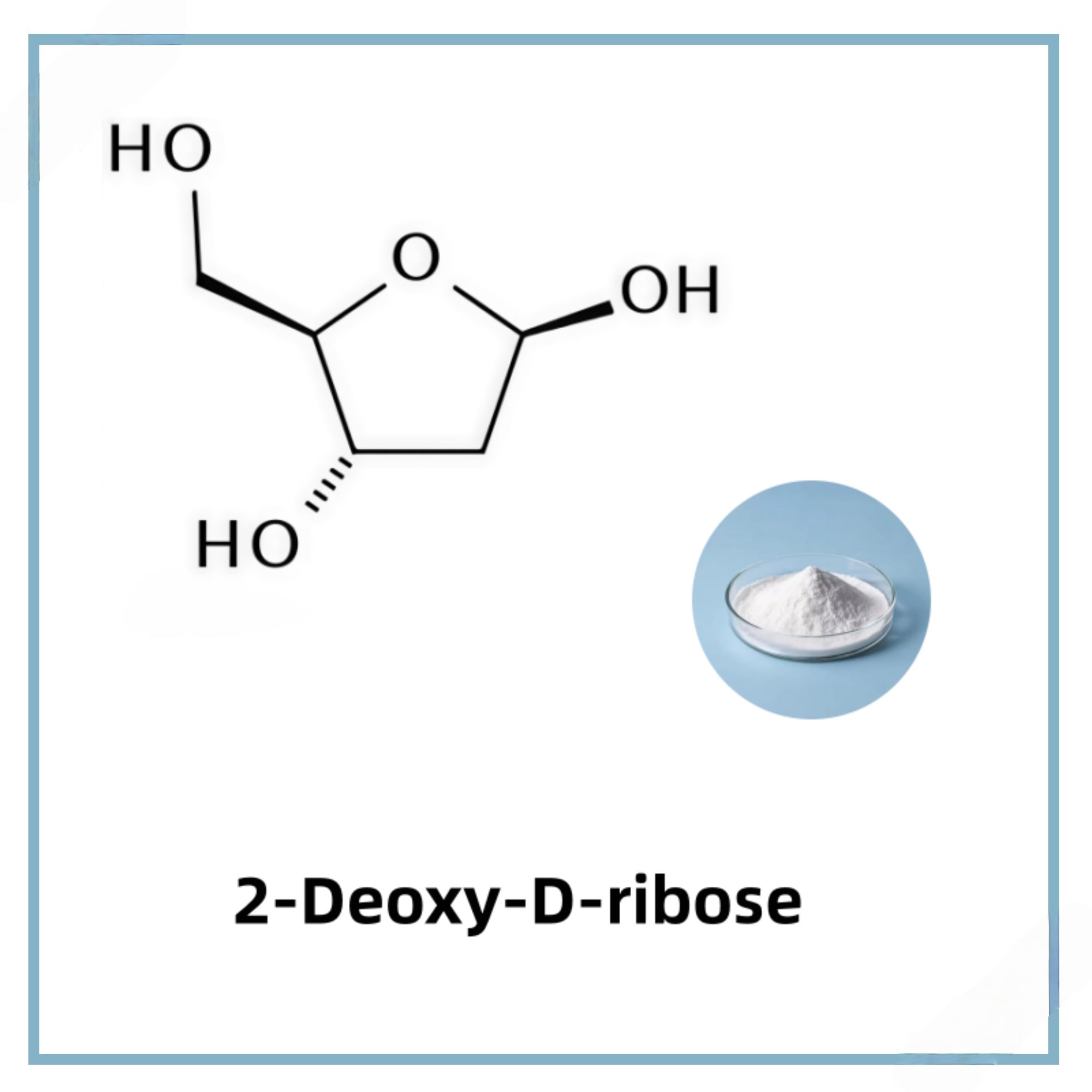
FULIBAI supplies 2-Deoxy-D-Ribose (2DDR) powder, CAS 533-67-5, for research, formulation development and commercial raw-material sourcing.
Batch-specific COA, samples, technical documents and batch consistency support are available for qualified projects.
| Product Name | 2-Deoxy-D-ribose |
| Abbreviation | 2DDR |
| CAS No. | 533-67-5 |
| Purity | 98% |
| EINECS No. | 208-573-0 |
| Molecular Formula | C₅H₁₀O₄ |
| Molecular Weight | 134.13 |
| Appearance | Crystal powder |
| Packing | 1kg/5kg Aluminum foil bag 25kg/Carton or as per customer's requirement |
| MOQ | 1 KG |
| Storage | Store in a cool, dry place, tightly sealed, away from heat and light |
| Payment | T/T, LC or DA |
| Delivery Time | Ready Stock in Local Warehouse, 1-3 days |
| Origin | China |
| Shipping | DHL, FedEx, TNT, EMS, By Sea, By Air |
For specialty ingredients such as 2-Deoxy-D-Ribose, one compliant COA does not always answer the most important question:
Will the next batch behave the same way?
Batch-to-batch consistency can be especially important for customers using 2DDR in formulation development, laboratory work or repeated production.
FULIBAI pays attention to consistency when evaluating 2DDR supply.
Where multiple production batches are available, key parameters can be compared across consecutive COAs, including:
For customers with strict internal specifications, consecutive batch COAs can be reviewed before long-term supply is confirmed.
This helps buyers understand whether the material remains within a stable quality range instead of evaluating only one individual batch.
Why Batch Consistency Matters for 2DDR Buyers
A raw material can meet its specification and still show variation between batches.
For some applications, that variation may not be important.
For others, especially formulation or research projects, changes in purity, moisture or other physical and chemical parameters can affect reproducibility.
This is why we recommend evaluating:
Specification limits + actual batch results + consistency across multiple batches
rather than checking only whether the material “passes” the COA.
For long-term projects, buyers can also define their own internal acceptance range for key parameters before regular purchasing begins.
Purity
Purity should be evaluated together with the analytical method used.
Two suppliers may both describe their material as “high purity” while using different specifications or analytical methods.
For that reason, the actual COA is more useful than a general product-page claim.
Identity
The material should be clearly identified as:
2-Deoxy-D-Ribose, CAS 533-67-5
Buyers with stricter internal requirements may also request additional identity or analytical information depending on the project.
Storage
Storage conditions should follow the current technical documents supplied with the batch.
For commercial orders, the recommended storage condition should also be considered during international transportation and warehousing.
| Test Items | Requirement | Result |
|---|---|---|
| Description | White or almost white crystalline powder | Confom |
| Loss on drying (55℃, 4 Hours) | ≤0.5% | 0.3% |
| Specific Rotation | -54°~-58° | -55.7° |
| Residue on ignition | ≤0.5% | 0.3% |
| Total Impurity | ≤1.0% | Confom |
| Heavy metals | ≤10ppm | Confom |
| Purity | ≥98.0% | 99.6% |
|
Conclusion:Qualified | ||
Before placing a commercial order, buyers can request a current COA and sample for evaluation.
Depending on the available batch and supplier documentation, FULIBAI can support:
Certificate of Analysis
SDS / MSDS
Product Specification
TDS
Origin information
Packing information
Batch comparison
Third-party testing when required
For customers with special analytical requirements, please provide the required test items before shipment so that testing capability can be confirmed in advance.
FULIBAI supports bulk 2-Deoxy-D-ribose powder supply for research and formulation projects.
Available support may include:
For buyers looking to buy 2-Deoxy-D-ribose, it is helpful to provide the target purity, required quantity, packaging, destination country and requested documents before quotation.
This allows us to confirm whether the available batch matches the project rather than quoting only on price.
How We Evaluate 2DDR Supply
For a specialty raw material such as 2DDR, supplier evaluation should not rely only on one number.
We normally pay attention to four areas:
1. Chemical Identity
The product should clearly match 2-Deoxy-D-Ribose, CAS 533-67-5.
2. Actual Batch Quality
The batch COA should be reviewed rather than relying only on a general specification sheet.
3. Batch Consistency
Where possible, consecutive batches should be compared to understand whether key quality parameters remain stable.
4. Documentation and Sample Support
The ability to provide samples, COA and technical documents is important before moving to larger commercial quantities.
For many specialty ingredients, these factors are more useful than comparing only the lowest price per kilogram.
What Should Buyers Check Before Ordering 2-Deoxy-D-Ribose?
Before approving a new source, we recommend checking:
These questions help prevent situations where two quotations look similar but are not technically equivalent.
Shandong Fulibai Chem Co., Ltd. Promises: We supply not only 2-deoxy-D-ribose powder, but also a guarantee you can trust and depend on.
1. What is the difference between ribose and 2-Deoxy-D-ribose?
2-Deoxy-D-ribose differs from D-ribose in its molecular structure. It lacks the hydroxyl group at the 2-position of the sugar molecule. This structural difference gives 2-Deoxy-D-ribose distinct chemical and biological properties and is why it is used separately in biochemical and research applications.
2. What does 2DDR stand for?
2DDR is a commonly used abbreviation for 2-Deoxy-D-Ribose, CAS 533-67-5.
3. What is the typical shelf life of 2-Deoxy-D-ribose?
Shelf life depends on the manufacturer, packaging and storage conditions. Buyers should follow the shelf-life and storage information stated on the current batch COA or technical documentation.
4. Can FULIBAI provide batch consistency information for 2DDR?
Yes. Where multiple production batches are available, FULIBAI can compare batch-specific COAs and key quality parameters to help customers evaluate batch-to-batch consistency before long-term purchasing.
5. Can I request a 2-Deoxy-D-ribose sample before ordering?
Yes. Samples can be arranged for evaluation according to the requested quantity, destination and available batch.
6. What documents are available for 2-Deoxy-D-ribose?
Depending on the available batch, FULIBAI can support documents such as COA, SDS/MSDS, product specification, packing information and other technical documents.
7. How is 2-Deoxy-D-ribose produced commercially?
Commercial 2-Deoxy-D-ribose is produced by chemical synthesis followed by purification and crystallization steps. The exact manufacturing route may vary between producers, so the process should be confirmed with the manufacturer when detailed production information is required.

Shandong Fulibai specializes in providing high-quality raw materials for the nutritional and cosmetic industries.
Floor 13, Block 1, No. 6888, Jiankang East Street, Weifang High-tech Zone, Shandong Province, China.
Copyright © 2026 SHANDONG FULIBAI CHEM CO.,LIMITED. All rights reserved. Privacy Policy
 EN