 EN
L-Theanine Powder: Natural, Synthetic or Fermented?
Ask three suppliers for an L-theanine quotation and the documents may look almost identical.
White crystalline powder. CAS 3081-61-6. Assay: 99%. Packed in 25 kg drums.
The prices, however, may be quite different.
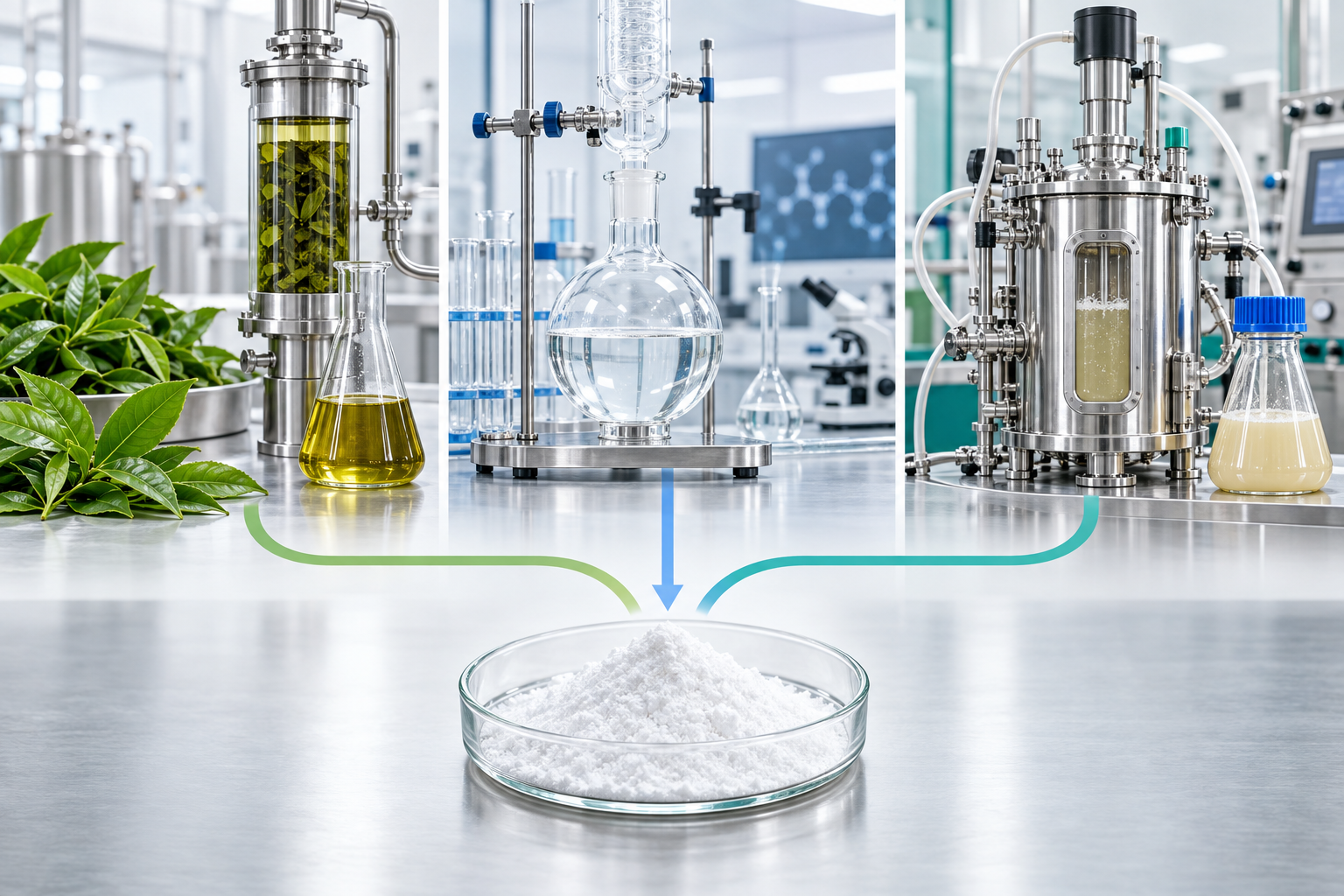
That difference often starts with the manufacturing route. Commercial L-theanine powder can be extracted from tea, produced by chemical synthesis or made through a biological process.[1] Each route has its own advantages, but it also leaves buyers with a different set of questions.
This matters because a 99% assay does not tell the whole story. It does not confirm where the material came from, how much D-theanine may be present or whether a “natural” claim can be supported in the target market.
Before choosing a supplier, it is worth looking beyond the first page of the COA.
First, What Does “Natural L-Theanine” Mean?
L-theanine is an amino acid naturally found in tea, particularly Camellia sinensis. Because of this connection, the word “natural” appears frequently in product descriptions.
In practice, suppliers may use the term in different ways.
One supplier may be offering L-theanine physically extracted from tea leaves. Another may use a biological conversion process and describe the resulting ingredient as naturally fermented. Unless the production route is clearly stated, the word alone tells a buyer very little.
There is also no universal rule allowing every fermentation-derived ingredient to be labelled natural in every country. The manufacturing inputs, processing aids and local regulations all need to be considered.
For a product marketed around natural sourcing, we would not rely on the word “natural” alone. The first thing to establish is where the L-theanine actually comes from. Tea extraction, chemical synthesis and biological conversion are three different supply chains, even though suppliers do not always describe them consistently.
A brief manufacturing flow is often more useful than another marketing certificate. It shows the starting material, the main conversion or extraction steps and how the final powder is purified.
Tea-Extracted L-Theanine
With a tea-extracted grade, the starting material is normally tea leaves or a tea-derived concentrate. Extraction itself is only the first step. The more difficult part is separating L-theanine from caffeine, polyphenols, other amino acids and the remaining plant components.
This route tends to appeal to brands that want a clear connection with Camellia sinensis. They may be prepared to accept a higher ingredient cost in return for a botanical source that is easier to explain on the finished-product label.
That source story still needs checking. Tea is an agricultural material, so its composition is not identical from one harvest to another. Growing region, season and preliminary processing can all influence what enters the extraction line.
For this reason, a buyer evaluating natural L-theanine should ask for more than an assay:
Botanical source and plant part
Country of origin
Extraction and purification process
Pesticide-residue testing
Residual caffeine
Heavy metals
Microbiological results
Solvent statement, if solvents are used
Traceability deserves attention as well. If a supplier claims that a highly purified white powder is extracted from tea, it should be able to connect the finished batch to its botanical starting material.
Researchers have studied stable-isotope analysis as one way of distinguishing tea-extracted L-theanine from certain synthetic products.[2] Most buyers will not need this test for every shipment, but its existence illustrates an important point: origin cannot always be established by an ordinary HPLC assay.
The US FDA’s GRN 338 concerns a specific L-theanine ingredient extracted from Camellia sinensis.[6] It covers the product and intended uses described in that notice. It should not be treated as a general GRAS certificate for every tea-extracted L-theanine on the market.
Chemically Synthesized L-Theanine
Chemical synthesis offers obvious commercial advantages. Production is not tied to tea harvests, output can be scaled and the physical specification is generally easier to standardize.
For price-sensitive formulations, synthetic L-theanine may therefore be a practical option.
The main technical issue is chirality.
Theanine has two enantiomeric forms: L-theanine and D-theanine. They have the same molecular formula, but their spatial structures are different. Depending on the synthesis and purification process, a chemically produced material may contain both forms.
This is where a basic “99% assay” can become misleading.
Some assay methods measure the total amount of theanine without clearly separating the L- and D-forms. A result close to 100% may therefore look impressive while providing limited information about optical purity.[3,4]
When assessing synthetic L-theanine, buyers should review the specific rotation and ask whether D-theanine has been tested by a suitable chiral method. Related substances, residual solvents, reagents and catalysts should also be considered according to the actual production process.
This does not mean that chemically synthesized L-theanine is automatically unsuitable for food applications. FDA GRN 501, for example, relates to a chemically synthesized L-theanine ingredient.[7] What it does mean is that the regulatory evidence must match the material being purchased.
A document issued for one manufacturer’s process cannot automatically be borrowed by another supplier simply because the product has the same CAS number.
Fermented L-Theanine: A Term That Needs Clarification
Fermented L-theanine has attracted considerable attention because it can combine industrial-scale production with controlled formation of the L-isomer.[5]
Still, “fermented” is one of the least precise descriptions used in this market.
It may refer to a genuine whole-cell fermentation process. In other cases, a supplier may use an isolated enzyme to convert substrates into L-theanine and market the material as fermented or bio-fermented. These processes are related, but they are not identical.
The difference matters when buyers prepare regulatory files or make non-GMO and natural-origin claims.
For a biologically produced grade, the process statement should clarify:
Whether microbial cells or isolated enzymes are used
The identity of the production organism
Whether the organism is genetically modified
The main fermentation or conversion substrates
Whether ethylamine is used
How cells and enzymes are removed
Whether residual protein or DNA is controlled
Do not rely on a “non-GMO” logo without reading the underlying statement. A product may be described as non-GMO because no genetically modified material is detected in the finished powder, while the production organism itself may require a separate explanation.
These details are not necessarily signs of a quality problem. They are simply part of understanding how the ingredient was made.
At the time of writing, FDA GRN 1311 concerns L-theanine produced with a specifically identified Escherichia coli strain, and the FDA page lists the agency’s response as pending.[8] Buyers should check the latest status directly rather than treating the filing as a completed GRAS conclusion.
How the Three Routes Compare
Point to compare |
Tea extraction |
Chemical synthesis |
Fermentation or bioconversion |
Starting point |
Tea-derived material |
Chemical raw materials |
Microbial or enzyme-based system |
Typical reason for choosing it |
Botanical-origin positioning |
Cost and stable industrial supply |
Controlled biological production |
Main quality concern |
Botanical contaminants and traceability |
D-theanine and process residues |
Process definition and production-organism documents |
Extra documents worth requesting |
Pesticides, caffeine and origin statement |
Chiral purity and residual solvents |
Strain, GMO, residual DNA and protein statements |
Natural claim |
Usually easier to explain |
Generally difficult to support |
Must be evaluated case by case |
There is no single route that suits every customer.
A tea-extracted grade may be the better fit for a premium botanical formula. A synthetic grade may make more sense when price and volume are the main concerns. A fermentation-derived grade may be attractive when the customer wants consistent L-configuration and a biological production story.
The correct choice depends on the finished product, destination market and claims the brand intends to make.
The Problem With Buying on Assay Alone
Assay is often the first number buyers compare because it is easy to understand. It is also easy to overvalue.
Suppose two suppliers both quote L-theanine powder with an assay of 99%. One tests by HPLC and provides chiral-purity data. The other provides only a general titration result. On paper, the two materials appear equal. From a quality-control perspective, they are not yet comparable.
A useful COA review should cover four separate questions.
Is It Really L-Theanine?
Check the identification method and confirm that the document refers to L-theanine rather than total theanine or an unspecified amino-acid content.
Is the L-Configuration Controlled?
Specific rotation provides useful supporting information. When optical purity is critical, ask for a chiral chromatographic result or a clearly stated D-theanine limit.
Are the Relevant Impurities Being Tested?
The impurity profile should reflect the manufacturing route. Pesticides and caffeine are particularly relevant to tea-derived material. Residual solvents and reaction-related substances matter more for chemical synthesis. Fermentation products may require information about residual protein, DNA and process substrates.
Will the Powder Work in the Intended Formulation?
A material can pass its chemical specification and still create problems during production.
For capsules or tablets, particle size, bulk density and flowability can affect filling and blending. Beverage manufacturers may care more about dissolution time, solution clarity, taste and stability at the intended pH.
“Soluble in water” is not enough information for an RTD beverage project. The sample should be tested at the planned concentration, temperature and pH, preferably in the actual formulation.
Documents to Request Before Placing an Order
For an initial supplier review, we normally suggest collecting the following documents:
Product specification
Batch-specific COA
Manufacturing-process statement
Allergen statement
GMO or non-GMO statement
Residual-solvent statement
Heavy-metals and microbiological reports
Country-of-origin statement
Stability or retest-period information
Relevant quality-system certificates
Additional documents should be requested according to the process and destination market.
A pesticide report is useful for tea-extracted material but may not answer the main risk questions for synthetic L-theanine. In the same way, a fermentation flow chart does not replace chiral-purity testing.
The document package needs to follow the product, not a standard checklist copied from another ingredient.
Questions Worth Asking an L-Theanine Supplier
Before comparing final prices, ask the supplier:
Which production route is used for the quoted grade?
Is “fermented” referring to whole-cell fermentation or enzymatic conversion?
How is D-theanine controlled?
Can the supplier provide a recent, batch-specific COA?
Which impurities are associated with this particular process?
What evidence supports the natural or non-GMO description?
Does the regulatory documentation belong to the actual manufacturer?
Has the product been tested in the intended application?
Can the sample and commercial order come from the same grade and process?
Is independent testing available when required?
Clear answers at the beginning can prevent expensive problems later. This is especially important when a formulation has already been approved or the product label makes a source-related claim.
Final Thoughts
Natural, synthetic and fermented L-theanine powder can all have a place in the market. The source name by itself does not decide whether a product is good or bad.
What matters is whether the stated production route is accurate, the analytical methods are appropriate and the documents belong to the material being supplied.
For procurement teams, 99% assay should be the beginning of the review—not the end.
Request L-Theanine Specifications and a Sample
WLB supplies L-theanine for dietary supplements, powdered blends and functional beverage projects.
Buyers can request the current specification, batch-specific COA, available manufacturing-process statements, third-party test reports and samples for formulation evaluation.
View our L-Theanine product page or contact us with your required grade, application, quantity and destination market.
References
1.Chen, Z., Wang, Z., Yuan, H., and He, N. “From Tea Leaves to Factories: A Review of Research Progress in L-Theanine Biosynthesis and Production.” Journal of Agricultural and Food Chemistry, 2021, 69(4), 1187–1196. https://doi.org/10.1021/acs.jafc.0c06694
2.Perini, M., Pianezze, S., Ziller, L., and Camin, F. “Characterization of L-Theanine in Tea Extracts and Synthetic Products Using Stable Isotope Ratio Analysis.” Journal of Food and Drug Analysis, 2021, 29(2), 312–319. https://doi.org/10.38212/2224-6614.3349
3.Desai, M. J., and Armstrong, D. W. “Analysis of Derivatized and Underivatized Theanine Enantiomers by High-Performance Liquid Chromatography/Atmospheric Pressure Ionization-Mass Spectrometry.” Rapid Communications in Mass Spectrometry, 2004. https://pubmed.ncbi.nlm.nih.gov/14755608/
4.“Comparison of Polarimetry and Crown Ether-Based HPLC Chiral Stationary Phase Method to Determine (L)-Amino Acid Optical Purity.” Journal of Pharmaceutical and Biomedical Analysis, 2012. https://pubmed.ncbi.nlm.nih.gov/22868097/
5.“A Comprehensive Review of L-Theanine Production in Escherichia coli: Recent Progress, Metabolic Engineering Strategies and Future Prospects.” ACS Synthetic Biology, 2025. https://doi.org/10.1021/acssynbio.5c00291
6.U.S. Food and Drug Administration. “GRN No. 338: L-Theanine Extracted from Tea Leaves (Camellia sinensis).” https://www.hfpappexternal.fda.gov/scripts/fdcc/index.cfm?id=338&set=GRASNotices
7.U.S. Food and Drug Administration. “GRN No. 501: L-Theanine (Chemically Synthesized).” https://www.hfpappexternal.fda.gov/scripts/fdcc/index.cfm?id=501&set=GRASNotices
8.U.S. Food and Drug Administration. “GRN No. 1311: L-Theanine Produced by Escherichia coli CICC 11189s.” https://www.hfpappexternal.fda.gov/scripts/fdcc/index.cfm?id=1311&set=GRASNotices