 EN
How is Creatine Monohydrate Made ?Manufacturing Process,Raw Materials &Quality Control
When we compare creatine monohydrate from different suppliers,the product name maybe exactly the same while the batch data are not.
One COA may show creatitine at around 58 ppm.Another may show only a few ppm.A standard 200 mesh powder can also have a very different bulk density from a super -fine grade.
So the useful question is not only how creatine monohydrate is made. For sourcing , it is also worth understanding which parts of production may affect the finished batch.
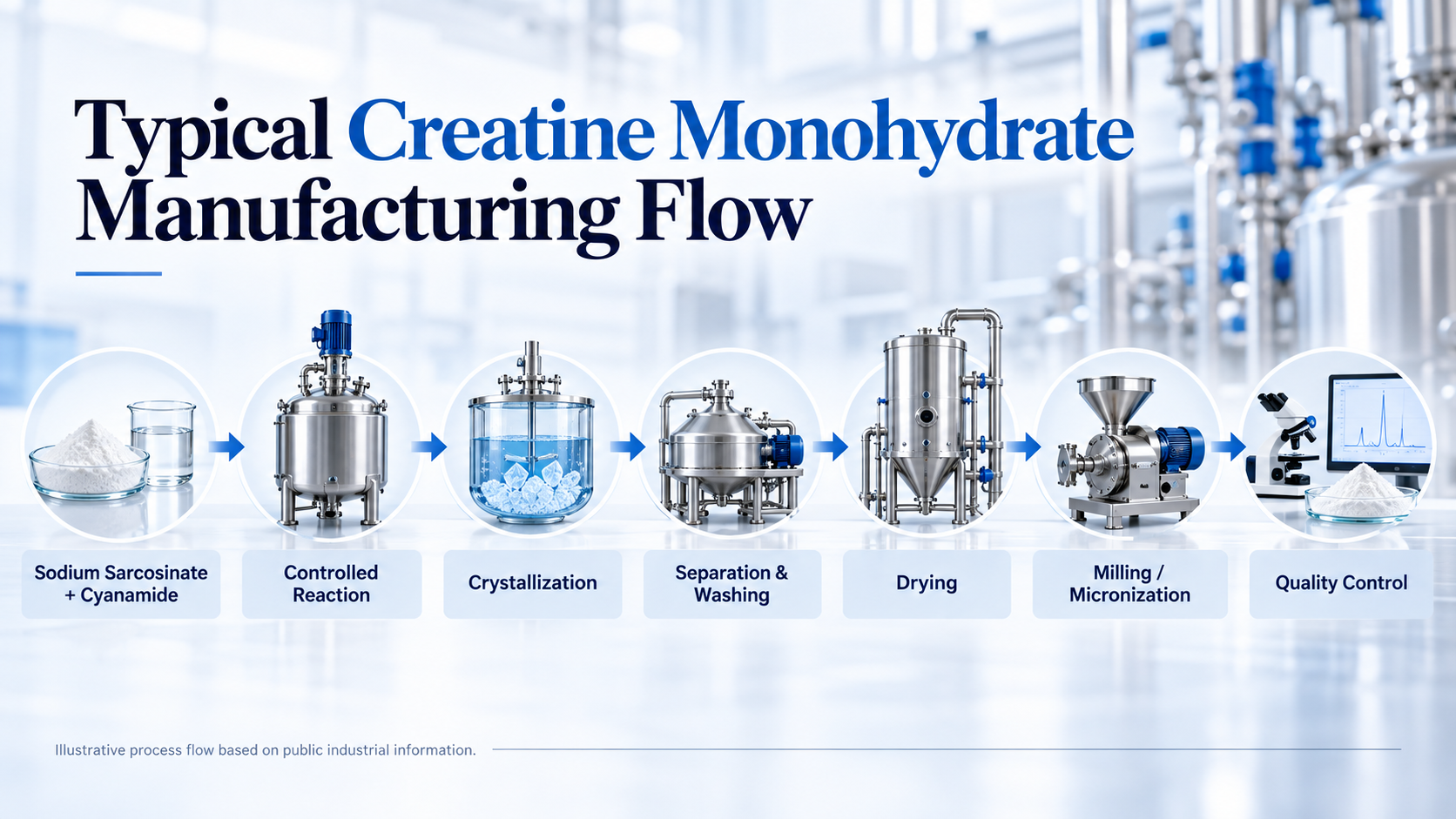
The best-documented industrial route starts with sodium or potassium sarcosinate and cyanamide. Published patents then describe reaction, crystallization, separation, washing and drying before the material is processed to the required particle size.[1][2][3]
What is Creatine Monohydrate Made From ?
Creatine occurs naturally in the body and in animal foods,but commerical creatine monohydrate for supplements is normally manufacturered rather than extracted from meat.
For industrial production, sodium sarcosinate and cyanamide are the two raw materials most often described in published processes.
The BASF patent US6759553B1, for example, describes reacting sodium or potassium sarcosinate with cyanamide in an aqueous system. The preferred reaction conditions in that patent are alkaline, particularly around pH 9-10, although the patent covers a wider opernating rang.[1]
An earlier patent, US5719319, also describes the sarcosinate-cyanamide route.[2]
This does not mean every factory follows exactly the same recipe.
One producer may buy sodium sarcosinate as an intermediate.Another may prepare it upstream.
Reaction concentration, pH control, feeding rate, purification equipment and recovery systems can all differ.
That distinction is important when reading manufacturing claims online. The chemistry may be well established, but a patent from one company should not be presented as the exact production method of every creatine manufacturer.
Vitaquest’s manufacturing overview also describes sodium sarcosinate and cyanamide as the principal materials used to make commercial creatine powder.[4]
How is Creatine Monohydrate Manufactured ?
At factory level, the process can be complicated. From a buyer’s point of view, however, it is easier to follow it in three parts: reaction, isolation of the crystals, and final powder processing.
Reaction Comes First
The sarcosinate solution is brought to the required reaction conditions and cyanamide is introduced.
This is where PH,temperature,concentration and reaction time start to matter.
The BASF patent gives a broad reaction range of 20-150℃ and pH 7-14, but identifies narrower preferred ranges. In one example, the sodium sarcosinate solution was adjusted to PH 9, heated to 75℃, and cyanamide solution was added over several hours.[1]
Those numbers are useful for understanding the chemistry, but they should not be copied into a supplier specification as though every factory operated at 75 ℃。
A newer Chinese patent describes another route involving sodium sarcosinate preparation, pH adjustment and reaction with cyanamide before crystallization.[3]
The broad chemistry is similar, The plant design is not necessarily the same.
Then the Creatine has to be Isolated
Finishing the reaction does not mean the product is ready.
Creatine still has to come out of the liquid reaction system.
Published processes generally do this by cooling the solution until creatine monohydrate crystallizes. In the BASF example, the reaction misture is cooled, the precipitated creatine is filtered, washed with water and then dried.[1]
The Chinese patent describes solid-liquid separtion,washing,centrifugal dewatering and reduced- pressure drying.[3]
This part of production deserves more attention that it usually gets in supplier brochures.
A good reaction is only part of the job. The crystals still need to be separated from the mother liquor and washed before drying. Some processes can also use recrystallication ad an additional purification step.[1]
For buyers, this helps explain why two products can both be called creatine monohydrate but still show different impurity results.
From Creatine Crystals to Creatine Powder
After drying,the material still has to be converted into the physical grade ordered by the customer.
This is where terms such as 80 mesh, 200 mesh, micronized and ultra - fine enter the picture.
Milling or micronization changes particle size.It does not automatically change the underlying chemical purity.
That sounds obvious,but it is one of the earliest things to confuse when comparing creatine products.
We can see the difference clearly in real supplier COAs.
A 200-mesh Natural Field batch showed a bulk density of 465 g/L and a tapped density of 880 g/L.
A super-micro grade from the same manufacturer showed 330 g/L bulk density and 510 g/L tapped density.
That is a meaningful physical difference.
It does not tell us that one grade is chemically purer than the other. It tells us that the powders will not necessarily behave the same during filling, mixing, packaging or formulation.
For this reason, particle size and chemical purity should be checked separately.
Buyers sourcing bulk creatine monohydrate powder should therefore review both particle-size specifications and chemical quality data rather than treating them as the same quality parameter.
What Do DCD, DHT and Creatinine Tell Us?
This is where a creatine COA becomes much more useful than a simple "99% purity" statement.
The related-substances section may include DCD, DHT, creatinine and unspecified impurities.
Dicyandiamide deserves particular attention because older creatine patent literature discusses cyanamide undergoing competing reactions under alkaline conditions, including dimerization to dicyandiamide. [2]
That does not mean a DCD result can tell us exactly how a factory ran a particular batch.
It does mean there is a technical reason to look at the result rather than ignoring everything except assay.
A different 200-mesh batch from Natural Field reported 0.0003% DCD, 0.0001% creatinine, no detected DHT and 0.002% total impurities.
Both manufacturers reported that their batches met the applicable specification.
This is a good example of why we prefer to see the actual test result rather than only a limit such as "NMT 0.01%".
A specification tells you where the acceptance line is.
The batch result tells you what was actually measured.
What Should We Check on a Creatine Monohydrate COA?
Assay is usually the first number a buyer sees, but it is only one part of our COA review. For example:Two COAs supplied to buyer specify an assay range of 98.0–102.0% on a dry basis, with reference to USP or USP–NF. The reported results were 100.14% for first COA batch and 99.98% for the second COA batch. Both results were within the ranges stated on their respective COAs. The higher number alone does not make one batch the better choice.
We also check which related substances were tested and how their results compare with the buyer's requirements. For creatine monohydrate, this may include DCD, DHT and creatinine. The heavy-metal section needs the same care: individual results for lead, arsenic, cadmium and mercury are more useful for review than a general statement without the underlying figures.
For food or supplement applications, we review the microbiological results listed on the batch COA. These may cover total plate count, yeast and mold, and specified organisms such as E. coli, Salmonella and Staphylococcus aureus. We then look at the physical properties, including particle size, bulk density and tapped density. These figures help a manufacturer judge how the powder may handle during production; they do not replace assay or impurity testing.
Why“USP Grade”Is Only a Starting Point
A supplier's “USP grade” description tells us which specification to examine. It does not answer every purchasing question. Two batches can meet their stated assay specifications while showing different impurity results or physical properties.
The next question is how the material will be used. A capsule manufacturer may need to pay close attention to density and flow. A buyer with internal limits for DCD or creatinine needs the measured batch results. Where a customer or destination market sets specific heavy-metal limits, we compare those limits with the batch COA and any available independent test report.
For that reason, FULIBAI asks for batch-specific documents before confirming whether a creatine monohydrate grade fits a customer's requirements.
Third-Party Testing
A supplier COA is normally the first piece of evidence available to a buyer.
For a new source, a larger commercial order or a customer with a specific quality requirement, an independent laboratory can add another level of verification.
For creatine monohydrate, the scope may include assay, related substances, heavy metals and microbiology depending on the project.
Third-Party Testing and Batch Quality Verification
Third-party testing can provide additional verification of creatine monohydrate quality beyond the supplier's routine Certificate of Analysis (COA).
For batch 20260820, a creatine monohydrate sample supplied by FULIBAI was independently tested by SGS. The testing covered related impurities, elemental impurities and microbiological parameters using USP-NF and USP <233> methods.
Key results included:
- Creatinine: 88 mg/kg
- Dicyandiamide (DCD): Not Detected
- Dihydrotriazine (DHT): Not Detected
- Lead (Pb): Not Detected
- Cadmium (Cd): Not Detected
- Arsenic (As): Not Detected
- Mercury (Hg): Not Detected
- Total Aerobic Microbial Count: 35 CFU/g
- Total Combined Molds and Yeasts Count: <10 CFU/g
- Staphylococcus aureus: Not Detected
- Salmonella: Not Detected
- Escherichia coli: Not Detected
These results provide batch-specific third-party data covering key related impurities, heavy metals and microbiological parameters. For bulk buyers, third-party testing can be used alongside the batch COA and product specifications when evaluating creatine monohydrate for supplement manufacturing.
Third-party test information and supporting quality documentation can be provided to qualified B2B customers upon request.
A Few Questions We Would Ask Before Buying
When we evaluate a creatine source, "Can you supply USP grade?" is not enough on its own.
We would also want to know which particle-size grades are available, whether the COA is from the actual batch, whether DCD/DHT/creatinine are tested, how particle size is verified, whether individual heavy metals and microbiology are included, and whether a representative sample can be supplied before the commercial order.
For micronized material, bulk and tapped density can also be useful.
Those questions usually tell us much more about a supplier than a purity claim on a product page.
FAQ
1.What raw materials are normally used to make creatine monohydrate?
Sodium sarcosinate and cyanamide are the most commonly documented starting materials in commercial creatine monohydrate production. Industrial patents describe reacting them in aqueous systems under controlled alkaline conditions before the creatine is crystallized and isolated. [1][2]
2.Is micronized creatine purer than 200-mesh creatine?
Not necessarily. Micronization is a particle-size reduction step. Purity has to be evaluated separately from assay and impurity results. Different particle sizes can also show different bulk and tapped densities even when both products meet their chemical specification.
A Note for Creatine Buyers
The manufacturing route is useful background, but the finished batch is what you are actually buying.
That is why we pay attention to both sides of the product: chemical data such as assay, DCD, DHT and creatinine, and physical data such as particle size and density.
A bulk creatine monohydrate supplier that can provide a current batch COA, clear physical specifications and independent testing when needed gives a buyer much more to work with than a simple "99%+ creatine" claim.
Contact the FULIBAI team to discuss your required particle size, quality specifications, packaging and order quantity.
References
1. BASF Aktiengesellschaft. Process for the Preparation of Creatine or Creatine Monohydrate. U.S. Patent US6759553B1. The patent describes the sodium/potassium sarcosinate and cyanamide route, reaction conditions, crystallization, filtration, washing and drying. Source
2. SKW Trostberg AG. Process for the Preparation of Creatine or Creatine Monohydrate. U.S. Patent US5719319A. Discusses creatine synthesis from sarcosinate and cyanamide as well as side-reaction considerations. Source
3. CN115260047A. Preparation Method of Creatine Monohydrate. Describes sodium sarcosinate preparation, cyanamide reaction, crystallization, separation, washing, dewatering and drying. Source
4. Vitaquest International. How Is Creatine Powder Made? Insights for Supplement Brands. Covers commercial raw materials, crystallization, drying, milling and quality testing from an industry perspective. Source
5. Caloong Chemical. Creatine Monohydrate Manufacturing Process. A commercial overview of creatine production and manufacturing considerations. Source