
 EN
Buying Creatine Monohydrate: Grades, MOQ & COA
One of our customers came to FULIBAI looking for creatine monohydrate. They knew how they wanted to use it, but had not chosen a mesh grade.
We helped match the grade to the application and worked out a trial-order quantity. That reduced the customer's initial purchasing cost without asking them to commit to a larger order before evaluation.
For buyers developing a product or testing a new supplier, this is often where the sourcing conversation needs to begin. Which powder should you try? How much do you need for the trial? What will the COA tell your quality team?

Woman performing a dumbbell lunge during strength training.
Start with the application when you don't know the mesh
You do not need to arrive with a finished particle-size specification to discuss an order.
FULIBAI supplies standard and micronized creatine monohydrate grades. If you already have an approved mesh requirement, include it in your enquiry. If you are still deciding, tell us the intended application and what the sample needs to do.
For example, a team evaluating powder dispersion has a different trial to plan from a team checking capsule filling. The grade recommendation should take that work into account. A higher mesh number alone does not establish better performance in your product.
In the customer enquiry above, the application gave us the starting point. We could then help select a suitable grade and trial quantity. We are keeping the customer's formulation and order details private; the useful lesson is that an uncertain mesh requirement need not hold up the enquiry.
Keep the first order proportionate to the trial
FULIBAI's minimum order quantity is 1 kg, and samples can be arranged for evaluation.
That gives a buyer room to test a proposed grade before making a larger commitment. A small trial can help answer practical questions about handling, mixing or filling while limiting the amount of material purchased at the development stage.
The right trial quantity depends on your process. A bench test and a production-line trial will not necessarily need the same amount. Tell us how you plan to evaluate the powder so we can discuss a quantity that fits the work.
Price matters here, too. FULIBAI offers competitive pricing, but the purchasing cost also depends on the grade and quantity selected. In the customer case, matching those two choices to the intended use helped reduce the initial cost. We have not attached a savings percentage because the order details are not being published.
Read the COA before approving the proposed material
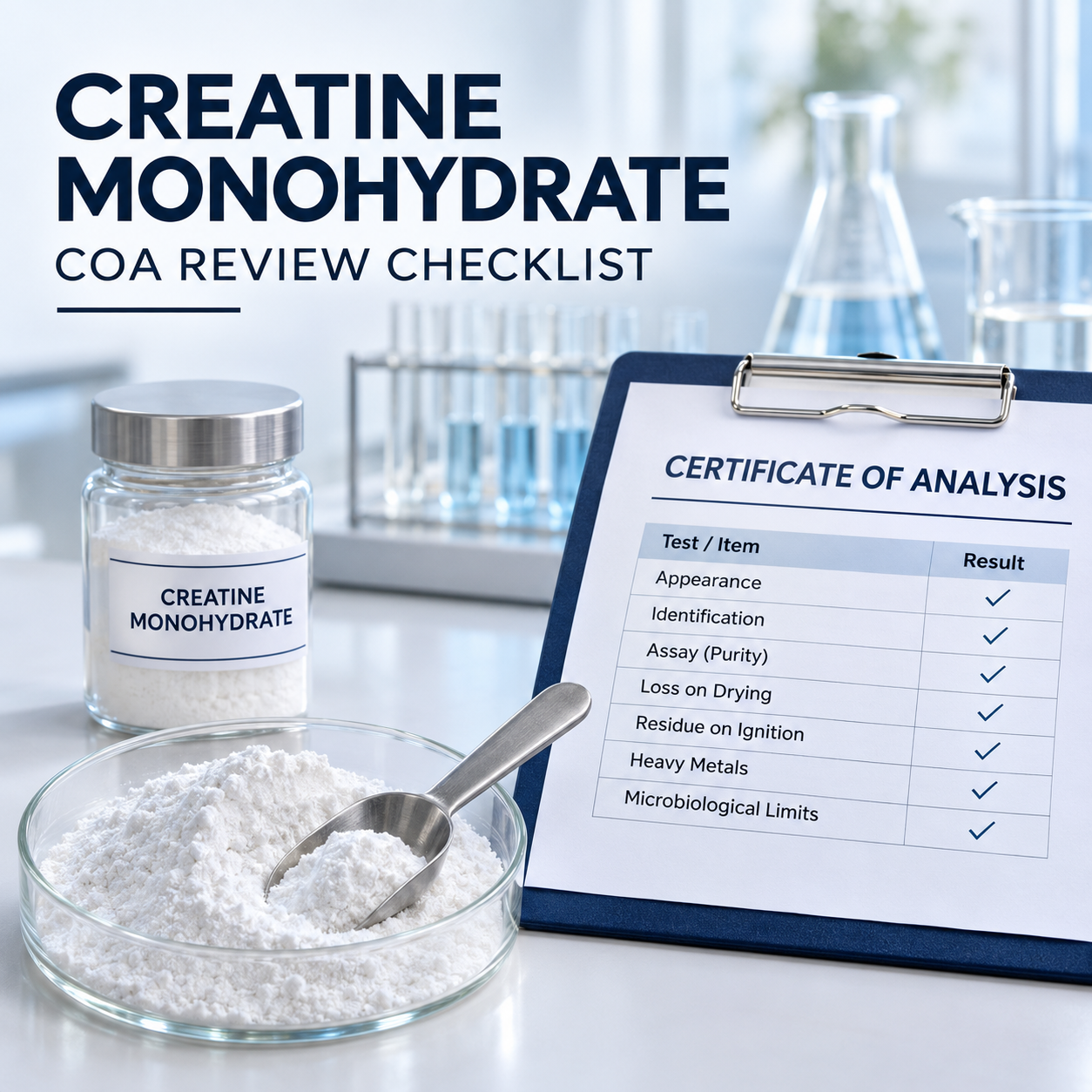
Creatine monohydrate powder and a reference COA on a laboratory bench.
Once a grade is under discussion, the quality review needs batch information. For background on how the ingredient is produced, see our guide to the creatine manufacturing process.
The reference COA supplied for this article describes ultra-fine creatine monohydrate, CAS 6020-87-7, from a 600 kg batch. Here are selected results from that document:
| Test | Specification on the COA | Reported result |
|---|---|---|
| Assay | 98.0–102.0%, stated on a dried basis | 99.4% |
| Loss on drying | 10.5–12.5% | 10.55% |
| Creatinine | Not more than 0.01% | 0.007% |
| Dicyandiamide (DCD) | Not more than 0.01% | Not Detected |
| Dihydrotriazine (DHT) | Not more than 0.0005% | Not Detected |
| Bulk density | Actual value | 180 g/L |
| Tapped bulk density | Actual value | 290 g/L |
These are results transcribed from one reference COA, rather than independent test results or fixed values for every shipment.
The reported creatinine level, 0.007%, is equivalent to 70 ppm. It is below the certificate's listed limit of 100 ppm. The assay and loss-on-drying results also fall within their printed ranges.
There are still details for a quality team to clarify. The assay's chemical form and drying calculation need to be understood before comparing its 99.4% result with a figure reported on a different basis. For DCD and DHT, “Not Detected” needs to be read with the method's reporting limit; it does not mean absolute zero.
Density can be relevant to a filling trial. This document gives both loose and tapped values, but actual performance on your equipment still needs evaluation.
A COA and a particle-size report answer different questions
The reference file is named “1000mesh creatine monohydrate.” Its table contains no particle-size result.
That distinction is important when choosing a micronized grade. The assay and impurity rows provide chemical-quality information. They do not establish the powder's particle-size distribution.
If mesh or particle size is part of your purchase specification, include it in the document request. The supporting result needs an agreed method and acceptance criteria. A laser-diffraction report, for instance, should identify the measurement conditions and relevant distribution values such as D10, D50 and D90.
This helps connect the trial to the later order. Your team needs to know which grade it evaluated and what specification to use when purchasing it again.
Quality and consistency matter after the sample passes
A successful sample is the beginning of a supply relationship. On a repeat purchase, the buyer needs material that meets the agreed quality and grade requirements.
FULIBAI's commitment is to product quality and batch consistency. For the purchasing discussion, that means establishing the required specification clearly: the grade, relevant quality limits and documents your team needs to review. A single reference COA provides information about one batch; it cannot demonstrate consistency across every future delivery.
Keep the approved requirements with your sample-evaluation record. They give both sides a clear basis for discussing repeat supply, rather than relying only on the description “creatine monohydrate powder.”
What to send with your enquiry
If you have a detailed specification, send it. If you only know the intended use, that is enough to start the conversation.
The most useful details are:
- Your application and what you want to evaluate.
- The mesh or particle-size requirement, if already decided.
- The amount needed for development or a trial.
- Your destination market and required quality documents.
FULIBAI can discuss standard and micronized grades, arrange samples and offer orders starting at 1 kg. We can also help match the proposed grade and trial quantity to your application, as we did in the customer enquiry described above.
Visit our creatine monohydrate product page to discuss your project. Include your intended use even if you have not selected a mesh grade yet.
References: