All Categories

COSMETIC INGREDIENTS

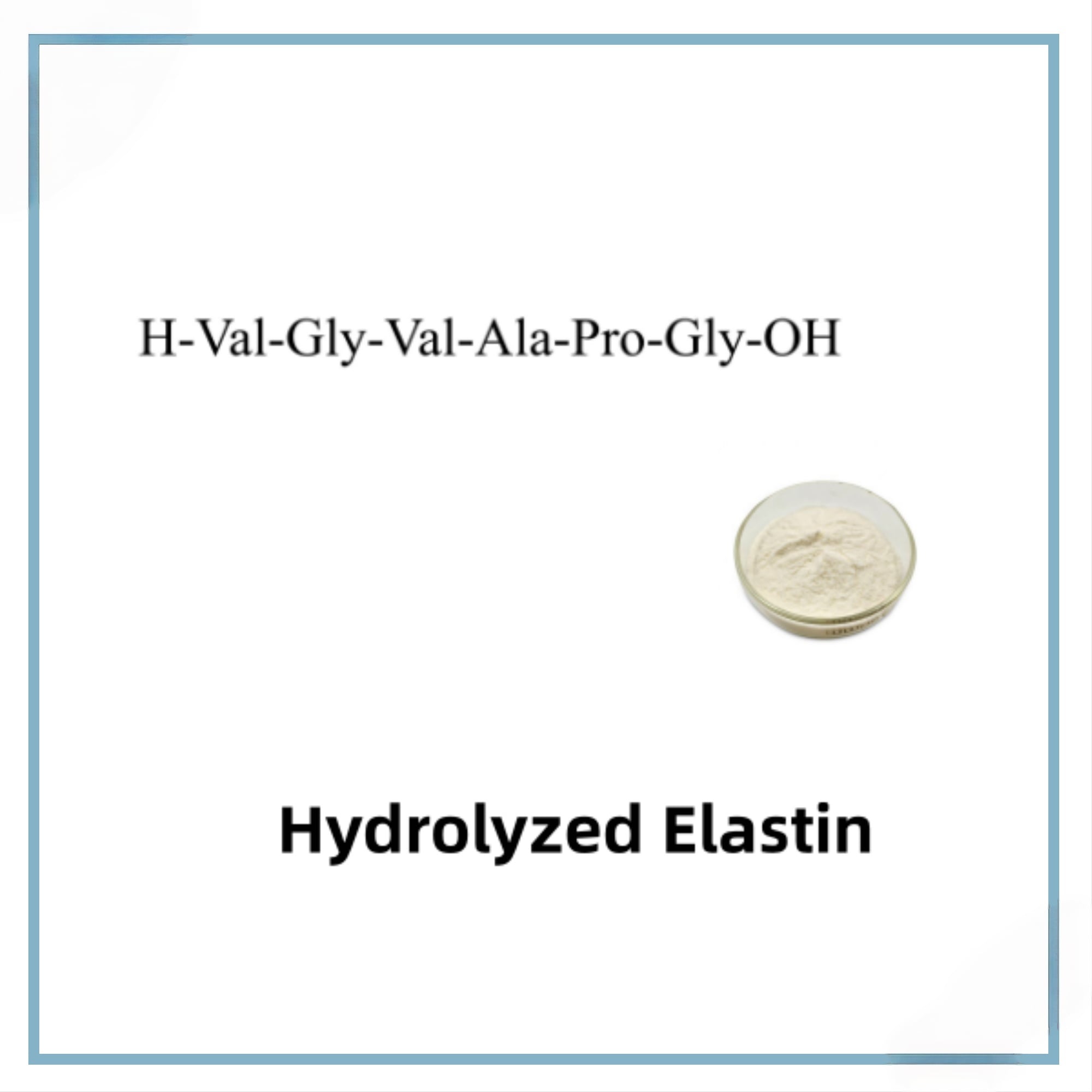
Hydrolyzed Elastin
CAS: 91080-18-1

Product Name Hydrolyzed Elastin
Appearance White or yellowish-white powder
Package 1kg/5kg Aluminum foil bag 25kg/Drum 25kg/Carton or customized as per customer's requirements
Storage Store in a cool, dry place, tightly sealed, away from heat and light
MOQ 1 KG
Payment T/T, LC or DA
Delivery Time Ready Stock in Local Warehouse, 1-3 days
Origin China
Shipping DHL, FedEx, TNT, EMS, By Sea, By Air 

Description

Hydrolyzed Elastin, in fact, is elastin that has undergone hydrolysis. Its appearance is white to pale yellow powder, hydrolyzed elastin is regarded as a “rubbery” ingredient that can maintains elasticity of human tissues. However, natural macromolecules can be barely absorbed by your skin, they are broken down into small-molecule peptides via hydrolysis. As a result, these small-molecule peptides have strong penetration capacity, which are readily absorbed by the skin. Hydrolyzed elastin is obtained from livestock byproducts. Common sources include fish skin, fish swim bladders, avian ligaments, as well as mammalian connective tissues like bovine and porcine nuchal ligaments. Thanks to our sophisticated production infrastructure, we have the flexibility to vary raw material origins to match different end-product needs. These requirements range from halal compliance and vegan formulation concepts to defined molecular weight targets. For reference, elastin sourced from marine fish skin offers enhanced biocompatibility alongside lower immunogenicity.

Applications

In the aspect of firming and elastic support, it can replenishes the supportive effect of depleted elastic fibres in the skin, improving skin firmness, elasticity and suppleness as well as alleviating sagging.
In the aspect of deep hydration and moisture retention, due to its excellent moisture absorption and film-forming properties, it forms a breathable protective layer atop the skin to minimise transepidermal water loss.
In the aspect of hair and scalp conditions, it can repair damaged cuticles and deliver silky texture, anti-static performance and enhanced lustre to hair in shampoos and hair care formulations.
In the aspect of sports nutrition and muscle recovery, since hydrolysed elastin undergoes pre-digestion, its dipeptides and tripeptides can be absorbed by the intestinal peptide transporter PepT1 within the intestinal tract. After exercise, supplementation with this ingredient rapidly raises blood amino acid concentrations, accelerates muscle protein synthesis (MPS) and notably shortens recovery periods following high-intensity training.
In the aspect of joint and bone health, hydrolyzed elastin provides essential amino acid nutrition to articular cartilage, ligaments and tendons. Besides, when paired with chondroitin sulphate and glucosamine, it helps to repair cartilage matrix and protects joint lubrication and mobility. Therefore, it is very suitable for elderly consumers and active sports participants.
In the aspect of gut health and medical nutrition, due to its low allergenic potential and minimal gastrointestinal digestive strain, it provides rapid nutritional support while supporting intestinal mucosal repair. It suits seniors with compromised digestive function, post-operative patients, infants sensitive to intact milk protein and other vulnerable groups.
Products and Usage Level:
In the field of anti-ageing and firming skincare, it is widely used as anti-wrinkle creams, firming serums, eye creams and neck creams, etc. Usage level is from 3.0% to 8.0%.
In the field of moisturizing and repair formulations, it is widely used as repairing masks, nourishing lotions, etc. Usage level is from 1.0% to 5.0%.
In the field of premium hair care, it is widely used as repairing hair masks, leave-in conditioners and scalp anti-ageing serums, etc.Usage level is from 0.5% to 2.0%.
In the aspect of hard or soft capsules, the recommended dosage of high-purity hydrolyzed elastin is approximately 50mg-200mg per day. Dosage per capsule or tablet is 20 mg-100 mg; recommended daily dosage: 50 mg ~200mg per day (about two tablets).
In the aspect of powders or sachets or protein shakes, it divides two parts, these examples are the following:
For sports nutrition products, such as hydrolyzed whey protein and soy protein, the single serving amount for reconstitution is 20g-35g that meets the protein threshold for muscle synthesis post-exercise; the recommended daily intake is 25g-60g.
For oral beauty and joint support formulations, such as high-dose collagen peptide complex powder, the dosage per sachet or single serving is 3g-10g (Note: Collagen peptides serve as the primary component, with hydrolysed elastin peptides typically incorporated at 50 mg -200 mg per serving.); the recommended daily intake is 3g-10g.
In the aspect of liquid drinks or shots, it divides two parts, these examples are the following:
For oral beauty shot bottles (standard volume: 30 ml-50 ml per unit), with small-molecule collagen peptides acting as the core carrier of active ingredients, per shot is 3000mg-10000mg or 3g-10g. Hydrolyzed elastin peptides that supports viscosity control of oral liquids is 50mg-200mg per shot; sodium hyaluronate that seems a beauty ingredient is 10mg- 50mg per shot.
In the aspect of sports energy and recovery shots (50 ml-100 ml per unit), for example, hydrolyzed whey protein peptides or BCAA peptides that focuses on rapid absorption and explosive energy supply is 5 g -15 g per shot.

Advantages

1. We adopt a targeted bioenzymatic hydrolysis technology. During the production process, hydrolysis temperature, pH value, reaction duration and enzyme dosage are precisely regulated through selecting specific proteases, such as trypsin, papain, complex flavour protease, etc.
2.Ultrafiltration and nanofiltration are widely used in the production process, and as a result, active peptide fractions can be accurately retained, inorganic salts, high-molecular-weight impurities and free small molecules can be removed. Fortunately, the product purity and batch-to-batch consistency can be secured.
3.We adopt an eco-friendly decolourisation and deodorisation process. In order to solve these common problems of off-colour and unpleasant odours, we adopt physical adsorption, activated carbon treatment and mild decolourisation techniques in modern production lines. Without compromising peptide activity, the process yields nearly colourless or pale yellow, transparent products free of undesirable odours, greatly expanding its applicability in premium skincare such as lightweight serums.
4.Hydrolyzed elastin has excellent aqueous solubility. In water, the material shows excellent aqueous solubility and dispersibility as a result of deep hydrolysis and micromolecularisation. Besides, it does not form precipitation and agglomeration, enabling downstream customers to develop formulations for diverse delivery forms including aqueous solutions, emulsions, lyophilised powders and capsules.

FAQ

Q1: What are the core differences between hydrolyzed elastin and hydrolyzed collagen?
A: The first difference is their functions. Among them, hydrolyzed collagen focuses on providing “compressive support and three-dimensional fullness”, while hydrolyzed elastin acts like a spring, delivering elasticity and resilience to the skin, blood vessels and ligaments. The second difference is properties of amino acids. Hydrolyzed elastin contains desmosine and isodesmosine that are crucial for imparting elasticity to tissues, while hydrolyzed collagen does not contain these components in premium formulations. However, they can also work synergistically. For example, hydrolyzed collagen is responsible for "plumping up" the skin, and hydrolyzed elastin is responsible for promoting skin resilience.
Q2: Why does hydrolyzed elastin need to be made into "small molecules"? What is the suitable molecular weight range?
A: Natural elastin features water insolubility, a very large molecular weight and extensive intermolecular cross-linking. For this reason, it is difficult for body and skin
to absorb. By contrast, through targeted enzymatic hydrolysis, hydrolyzed elastin is broken down into small-molecule peptides. Its molecular weight is controlled between small-molecule peptide. In the range of this molecular weight, hydrolyzed elastin not only delivers excellent water-solubility, but also penetrates the stratum corneum. Besides, in oral nutritional supplements, hydrolyzed elastin is effectively absorbed by the intestinal tract , achieving firming and anti-aging effects.
Q3: What are the main sources of hydrolyzed elastin? Is it safe?
A: Of course. Currently, industrially produced hydrolyzed elastin is derived from two primary sources, including marine and mammalian sources.
In the field of marine sources, hydrolyzed elastin is extracted from deep-sea fish skin and swim bladders. Because the molecular structure of these fish is highly compatible with human tissues, and the resulting hydrolyzed elastin exhibits low immunogenicity. Therefore, this material is widely used in the beauty-cosmetics and nutricosmetics markets.
In the field of mammalian sources, hydrolyzed elastin is extracted from high quality mammalian connective tissues. Through rigorous enzymatic hydrolysis, deodorization, decolorization and microbial control, producers ensures all products are free of heavy-metal residues and sensitizers, complying with the international cosmetic and food safety standards.
Q4: Is hydrolyzed elastin prone to precipitation, turbidity, or stratification in formulations? How is stability ensured?
A: Small molecular hydrolyzed elastin delivers excellent transparency and solubility in water via extensive hydrolysis and advanced ultra-filtration purification, resulting in no precipitation at regular dosages.
The following are the recommendations for formulation stability:
Firstly, when the pH value is controlled at 3.5 to 7.0, hydrolyzed elastin becomes more stable. However, slight precipitation or hydrolysis may occur under extreme acidic or alkaline conditions.
Secondly, since it is essentially a peptide, it should not be combined with strong oxidizing agents or high-concentration alcohol in formulations. Hydrolyzed elastin should be added to the aqueous phase, and the temperature of the aqueous phase during addition should be kept below 40°C–50°C to preserve its activity.
Q5: In the future, will there be fermentation process or recombinant human-derived elastin compared to plant and animal extracts?
A: Driven by advances in synthetic biology, the production of recombinant human elastin and specific functional peptide fragments via genetically-engineered yeast or engineered E. coli has gained traction across the industry.
There are some advantages and current states. Recombinant technology is independent of animal by-products, making the raw materials exhibit high purity, stability, non-viral properties and lo-allergenic characteristics. Currently, this technology is gradually transitioning from small-scale research and development to industrial mass production. It believes that in the future, this technology will demonstrate great potential for substitution and performance upgrading in premium medical aesthetics and high-performance skincare products.

Regulatory compliance

China: Hydrolyzed elastin extracted from mammalian sources or marine sources is listed as a legal ingredient in the Inventory of Existing Cosmetic Ingredients in China (2021 Edition) issued by NMPA.
European Union: In the premium markets of Europe and the US, elastin derived from marine sources, such as fish skin or bladders, or non-ruminant animals tends to have more convenience during customs clearance and qualification review.
United States: If exported as nutraceuticals, producers must comply with FDA regulations regarding dietary supplement ingredients and cGMP standards. What’s more, producers also provide safety and historical consumption evidence.
Russia: When exporting hydrolyzed elastin and its downstream skincare products to Russia and the Eurasian Economic Union market, mandatory certification or a Declaration of Conformity per the regulations must be met.
Japan: Hydrolyzed elastin is classified as a regular legal ingredient in the Japanese Standards of Cosmetic Ingredients (JSCI or JSQI) or the ICHD or INCI system.
Australia: The Australian Industrial Chemicals Introduction Scheme (AICIS) manages all chemicals and biological materials imported into Australia. Hydrolyzed elastin is listed in AICIS’s chemical registry.

Get a Free Quote

Our representative will contact you soon.
Email
Name
Company Name
Message
0/1000

Get a Free Quote

Our representative will contact you soon.
Email
Name
Company Name
Message
0/1000
Call
+86-18265650337
WhatsApp
hydrolyzed elastinbrcas 91080 18 1-0
Email Inquiry

Get a Free Quote

Our representative will contact you soon.
Email
Name
Company Name
Message
0/1000