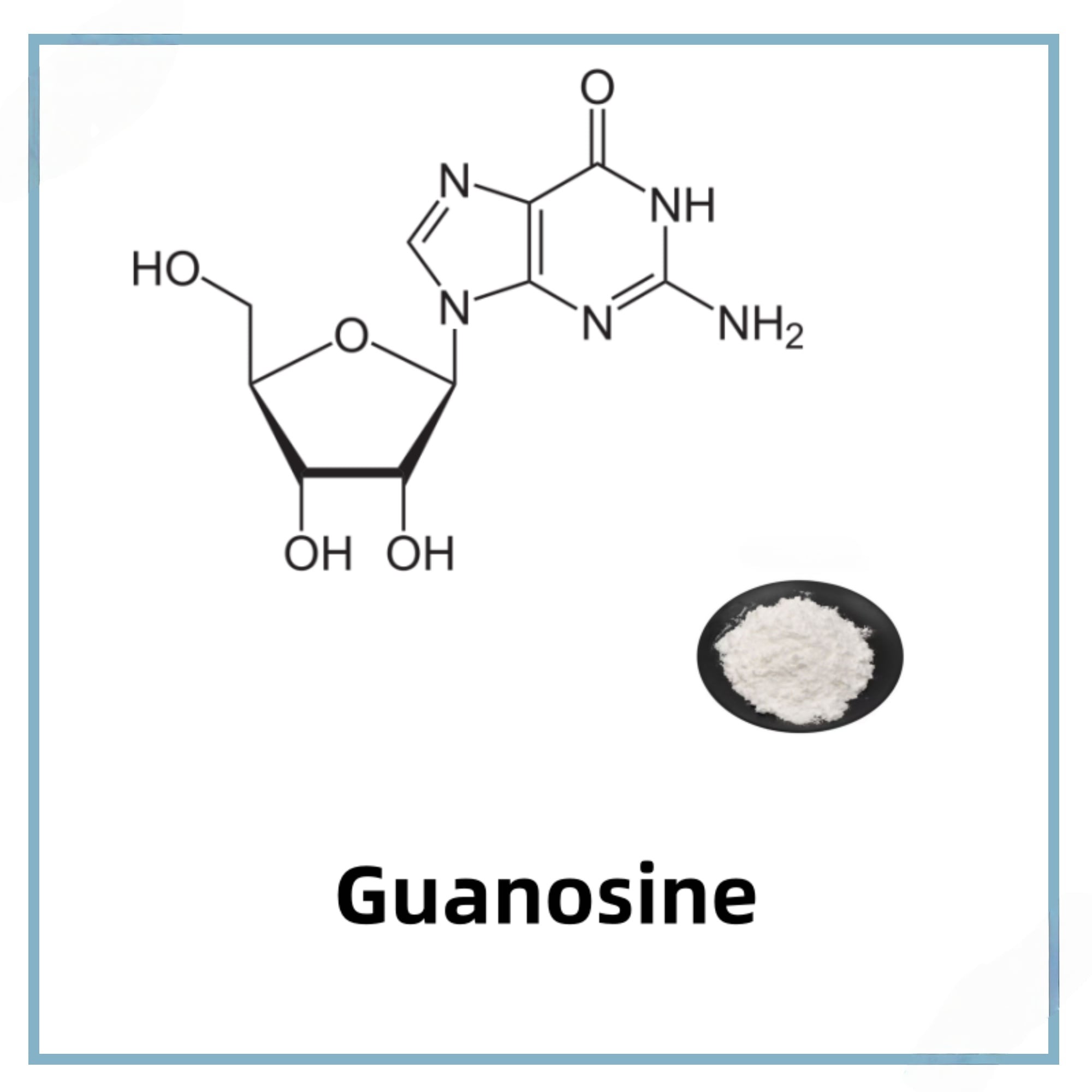
| Product Name | Guanosine |
| Other Name | O-(BETA-D-RIBOFURANOSYL)GUANINE |
| CAS No. | 118-00-3 |
| Purity | 97% |
| EINECS No. | 204-227-8 |
| Molecular Formula | C₁₀H₁₃N₅O₅ |
| Molecular Weight | 283.24 |
| Appearance | White crystalline powder |
| Packing | 1kg/5kg Aluminum foil bag 25kg/Drum 25kg/Carton or as per customer's requirement |
| Storage | Store in a cool, dry place, tightly sealed, away from heat and light |
| MOQ | 1KG |
| Payment | T/T, LC or DA |
| Delivery Time | Ready Stock in Local Warehouse, 1-3 days |
| Origin | China |
| Shipping | DHL, FedEx, TNT, EMS, By Sea, By Air |
Guanosine, as one of the four main nucleosides of Ribonucleic Acid (RNA), is a glycoside made by guanine and ribose ring.
1.Guanosine is a starting material for the synthesis of antitumor and antiviral drugs (such as Acyclovir and Ganciclovir, etc.)
2.Guanosine, as one of the nucleoside components, can help regulate the immune system in infant formulas.Infants have limited capacity for endogenous nucleotide synthesis. Therefore, supplemental guanosine directly participates in the metabolism and repair of intestinal epithelial cells and stimulates the proliferation of probiotics such as Bifidobacteria.
3.Guanosine is the key precursor material for the industrial synthesis of 5’-GMP. When 5’-GMP is combined with MSG (Monosodium Glutamate) or 5’-IMP, it produces umami synergy with exponential amplification and enhances umami by dozens of times, masking the bitter taste and beany flavor of certain plant proteins.
4.In molecular biology and life sciences, guanosine as a high-purity biochemical reagent, is a core substrate for nucleic acid research and genetic testing. Furthermore, it is commonly processed into dGTP and GTP, two indispensable substrates for PCR amplification, DNA/RNA sequencing (NGS) and in vitro transcription (IVT) kits.
| Test Items | Standard / Enterprise requirement | Result |
|---|---|---|
| Description | White or almost white crystalline powder | Conform |
| Loss on drying | ≤1.5% | 0.29% |
| Assay (dry content) | 97.0%-103.0% | 102.1% |
| Residue on ignition | ≤0.2% | 0.09% |
| Heavy Metals | ≤10ppm | <10ppm |
| Transmittance (Acid dissolution method) | ≥90.0% | 94.8% |
| Transmittance Base (dissolution method) | ≥90.0% | 93.5% |
| Conclusion: Qualified | ||
1.Guanosine is typically produced using a fermentation process. With over a decade of dedicated experience in the industry, we have a more acute sense of how fluctuations in the cost of upstream carbohydrates and bases affect guanosine’s price, enabling us to provide “incisive” purchasing timing suggestions for clients.
2.We can accurately identify differences in purity across the biological synthesis pathway and primarily select high-quality supplies with low solvent residue and zero microbial contamination, ensuring the products are not only a white powder, but also a kind of premium product that complies with pharmacopoeia standards.
3.Leveraging our comprehensive portfolio in fine chemicals and life sciences, we offer a robust selection of highly synergistic raw materials—ranging from premium nucleosides to bio-active cosmetic ingredients. We provide global clients with a seamless, one-stop sourcing solution that integrates technical consultation, regulatory compliance, and customized specifications, significantly reducing your formulation development cycle.
4.Because we are closely involved in research and development, the cost of communication is rapidly reduced. Most importantly, we ensure that each technical detail (such as specific rotation and absorbance index) is accurately implemented.
Q1: What manufacturing process is used to produce the guanosine?
A: Guanosine is produced through biological fermentation. Compared with the traditional chemical synthesis, this process has a higher optical purity and lower harmful solvent residues that excellently comply with the “green and purity” requirements for premium nutritional products and pharmaceutical intermediates.
Q2: What role does Guanosine play in infant formula or nutritional supplements?
A: As an exogenous nucleoside naturally present in breast milk, guanosine plays an essential semi-essential nutrient role in early-life growth and immune system. As modern nutrition continues to mimic human milk composition, guanosine serves a vital purpose in premium maternal and infant formulas and dietary supplements. Below are its three major advantages:
Promote Intestinal Tissue Maturation and Mucosal Barrier Repair: Infants have immature organs, so they cannot synthesize nucleotides via the in vivo salvage pathway, resulting in an exogenous nutritional gap. On the nutritional side, guanosine is readily taken up and used by enterocytes. It helps intestinal villi grow and differentiate, and reinforces the intestinal mucosal barrier. Overall, it boosts infants’ absorption of proteins, minerals and other nutrients, and cuts down cases of nonspecific diarrhea including rotavirus enteritis.
Driving T cell maturation and comprehensive immune modulation: Studies in clinical nutrition have confirmed that exogenous supplementation with guanosine and other nucleoside components can directly stimulate peripheral blood mononuclear cells to secrete cytokines, promote the maturation and differentiation of T lymphocytes, and significantly enhance the biological activity of natural killer (NK) cells. When guanosine is added to infant formulas and immune supplements, it helps build the body’s adaptive and innate immune defense systems across multiple dimensions and boosts resistance to infection.
Regulate Gut Microecology & Support Probiotic Colonisation: Guanosine plays a modulating exerts a prebiotic-like modulating effect in intestinal metabolism. It targetedly promotes the proliferation and colonization of beneficial flora such as Bifidobacteria and Lactobacilli in the intestine, while inhibiting the growth of pathogenic bacteria such as Escherichia coli, thereby optimizing the delicate intestinal microecological balance from the inside out in infants and young children.
Q3: How can the quality of guanosine be verified using technical specifications?
A: In addition to basic HPLC purity 97%, we pay more attention to specific rotation (usually between -60° to -64°), which is the key index to check the correctness of D-configuration chirality. Besides, we always strictly control for heavy metals and microbial residues to satisfy the applications of pharmacopoeia grade.
Q4: Given the rapidly fluctuating market, how do you ensure the stability of your supply?
A: This is the crucial advantage. As a decision maker who has thirteen years of experience in the field of fine chemical, we have a strong ability to integrate resources. In other words, we not only monitor cost fluctuations from the upstream fermentation raw materials, but also bypass lengthy approval procedures, thereby achieving formulation and dispatch rapidly from laboratory samples to bulk tonnage orders in the shortest time.
Shandong Fulibai specializes in providing high-quality raw materials for the nutritional and cosmetic industries.
Floor 13, Block 1, No. 6888, Jiankang East Street, Weifang High-tech Zone, Shandong Province, China.
Copyright © 2026 SHANDONG FULIBAI CHEM CO.,LIMITED. All rights reserved. Privacy Policy
 EN
EN