All Categories

COSMETIC INGREDIENTS

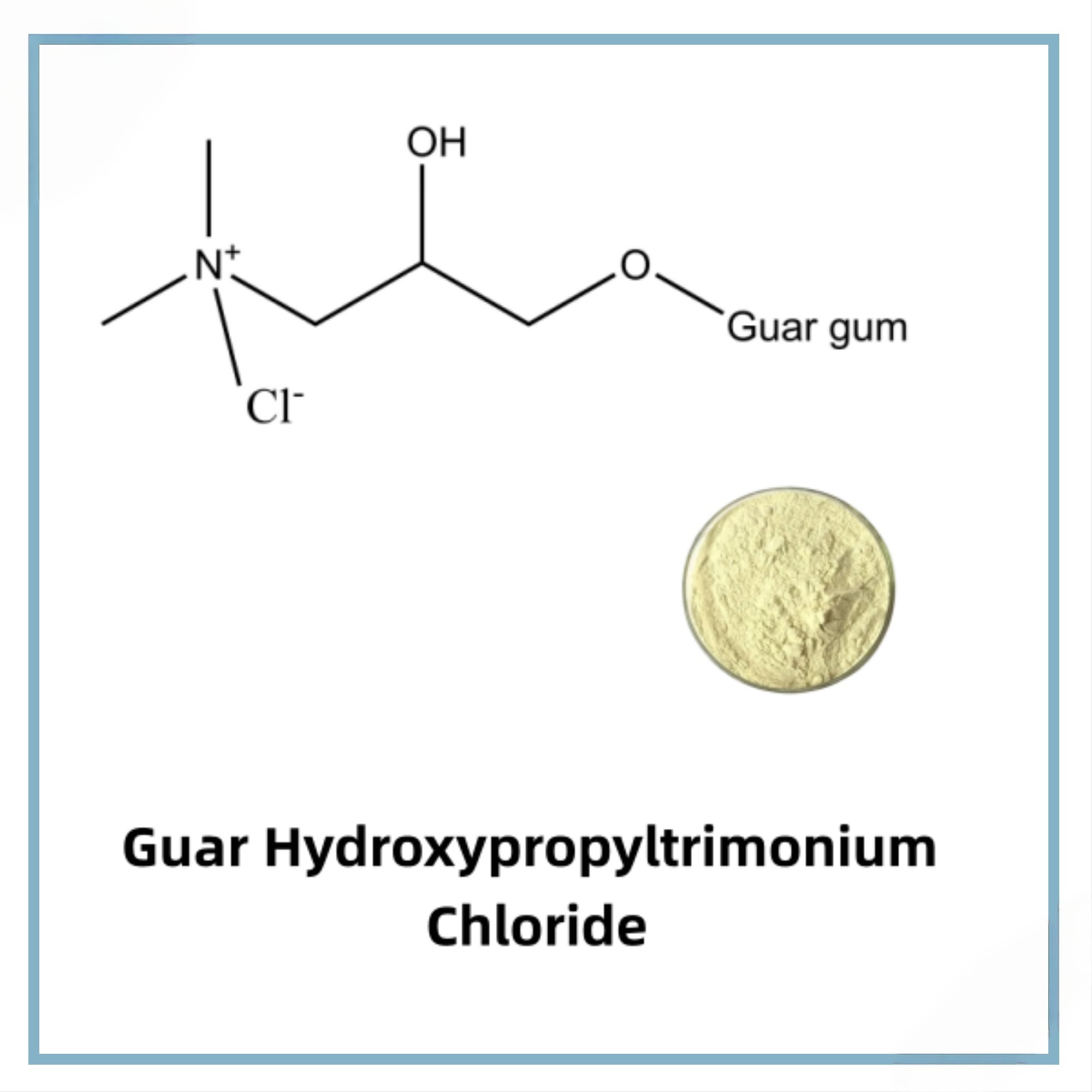
Guar Hydroxypropyltrimonium Chloride
CAS:65497-29-2

Product Name Guar Hydroxypropyltrimonium Chloride
Purity 99%
Molecular Formula R1-CH=CH-(CH2)n-SO3Na R2-CH(OH)-(CH2)n-SO3N 
Appearance White or yellowish-white powder with a characteristic odor
Packaging 1kg/5kg Aluminum foil bag 25kg/Drum  25kg/Carton or customized as per customer's requirements
Storage Store in a cool, dry place, tightly sealed, away from heat and light
MOQ 1 KG
Payment T/T, LC or DA
Delivery Time Ready Stock in Local Warehouse, 1-3 days
Origin China
Shipping DHL, FedEx, TNT, EMS, By Sea, By Air 

Description

Guar hydroxypropyltrimonium chloride is a common ingredient in cosmetics, a common ingredient in cosmetics that functions as a conditioning agent and thickener in hair and skincare formulations. It is derived from natural guar gum and adsorbs onto hair and skin via cationic charge with the help of chemical modification.

Specification

Testing Items Specifications Result
Appearance yellowish to yellow powder Conforms
Particle size through 120 mesh 99%min 99.90%
Particle size through 200 mesh 90%min 94.10%
Apparent Viscosity μ(1% sol., Brookfield, Spindle 3#,20 RPM, 25℃), mPa.s 3000-4500 4420
PH (1.0% sol) 9.0-11 9.88
Nitrogen% 1.2-1.7 1.41
Ash,% 3max 1.1
Moisture (105℃, 30 min.) 10 max 8.4
Aerobic Plate Count, cfu/g 500 max 50
Mould and yeast, cfu/g 100 max Undetected
Conclusion This product conforms to the standard Q/GRLH001-2013.

Applications

1. Functions and Effects
In the aspect of conditioning and anti-static properties, as a cationic polymer, it carries a positive charge that can neutralize the commonly occurring negative charges on the surface of hair and skin, effectively reducing static electricity and preventing frizz, making detangling extremely smooth (whether on wet or dry hair).
In the aspect of film-forming and affinity, because it creates a very thin, breathable protective film on the surface of hair and skin, the products deliver excellent moisturizing sensations and a silky feel.
In the aspect of thickening and rheological adjustment, it offers a certain thickening effect that improves the texture and rheological properties of products in aqueous systems. Therefore, lotions or hair care products have better adhesion and feel. In terms of mildness and skin compatibility, it exhibits lower skin and eye irritation potential than traditional synthetic quaternary ammonium surfactants. Meanwhile, it works compatibly with various surfactants, such as anionic, amphoteric, etc.
2. Application Areas
Hair care and cleansing products: It improves wet and dry combability of damaged hair while leaving hair soft, voluminous and lustrous. For this reason, it is widely incorporated into shampoos (particularly 2-in-1 formulations), conditioners, hair masks, and colouring and repair creams.
Cleansing and bathing products: Because it brings a smooth, non-drying moisturizing feel on the skin, it is widely used in body washes, facial cleansers and hand cleansers to improve the products’ post-wash skin feel.
Styling and skincare products: Occasionally found in styling products or certain lotions and creams, it is used to adjust product texture and provide gentle conditioning and moisturizing sensations.
3. Usage Level
Shampoos, body washes, cleansing products: 0.2% - 1.0%
In daily wash products, this range can provide good wet combing properties and post-wash smoothness without causing excessive residue or sediment.
Conditioners, hair masks, deep repair products: 0.5% - 2.0%
For repairing damaged hair or for creams requiring strong moisturization and anti-static properties, the usage level will be increased to promote the silky feel and sleekness of the hair.
Leave-in styling products, sprays: 0.1% - 0.5%
Lower dosage levels are required in lightweight leave-in products to prevent tackiness and heavy hair feel.

Advantages

1. Strict quality and indicator control (High-purity and low free residues)
Quality stability: Produced by advanced etherification reactions and refining processes, the molecular weight distribution, cationic substitution degree (DS), and residual impurities of the product are strictly controlled.
Low free amine and low odor: To satisfy stringent demands on skin feel and safety profile for cosmetic use, this product undergoes effective decolourisation, deodorisation and by-product elimination. Each batch features consistent colour, viscosity and odour. Accordingly, it fits the standards required by premium personal care brands.
2. Scalable capacity and stable supply chain assurance
Direct supply from source factory: Equipped with mature and stable large-scale production lines, we can ensure ample inventory and continuous output, effectively avoiding stock-out risks due to seasonal raw material shortages in the industry.
Flexible customization services: We not only offer standard specifications, such as cosmetic grade and daily chemical grade with different viscosity levels, but can also adjust packaging specifications, viscosity indicators, or provide customized compounding solutions according to the customer’s formulation needs.
3. Comprehensive compliance qualifications and technical support
Complete quality documentation: Comprehensive technical documentation can be provided with each batch, including TDS, MSDS, COA, and regulatory compliance support materials.
4.Professional technical application empowerment: We have conducted in-depth research on the compatibility and compounding logic of this raw material in hair and body wash products. Therefore, we can provide full-process technical support for overseas R&D and procurement clients, from dosage suggestions and hydration operation guidelines to formulation optimization.

FAQ

Q1: How should this ingredient be added and operated in formulations?
A: Slowly introduce the ingredient into the aqueous phase with adequate stirring to enable complete hydration and dispersion. pH adjustment or pre-wetting may be utilised according to formulation parameters and ionic characteristics for ideal viscosity and clarity.
Q2: What is the difference between cosmetic-grade and regular-grade?
A: For cosmetic-grade material, high purity, low residual impurities and low odour are essential metrics. Strict control over the degree of cationic substitution (DS) and molecular weight distribution brings favourable skin and hair compatibility, low irritation potential, and high transparency when used in clear formulations.
Q3: What documents and quality certificates can be provided?
A: We can provide comprehensive document support for each batch, including TDS, MSDS, and COA.
Q4: What are the standard packaging and MOQ?
A: We typically use standard 25 kg cardboard drums or paper-plastic composite bags lined with PE. Most importantly, we also arrange flexible packaging and customized sample amounts for laboratory testing based on customer requirements. Please contact our sales team for specific MOQ details.
Q5: What is the recommended pH value in formulations?
A: It stays stable and performs reliably over a broad pH range of 4.0 to 8.0. This lends good compatibility with most conventional hair and skincare formulations including shampoos, conditioners and body washes.
Q6: Is this product compatible with anionic surfactants in shampoos?
A: Yes. As a cationic polymer, it maintains good compatibility with common anionic, non-ionic and amphoteric surfactant systems. However, in order to prevent potential coalescence or sedimentation issues, proper addition sequence and dispersion steps should be adopted during the manufacturing process.

Regulatory compliance

United States: This ingredient is approved by the FDA for use in cosmetics and personal care products, and the FDA does not enact any bans or special restrictions. Therefore, it is widely used as a conditioning agent and sedimentation aid in rinse-off products, such as shampoos and body washes.
Canada: Health Canada has not prohibited or restricted this ingredient in cosmetics. It is not listed on Canada’s official Cosmetic Ingredient Hotlist. Meanwhile, it is not included in the high-priority controlled chemicals list by Environment and Climate Change Canada (ECCC).
Australia: This ingredient is listed as a compliant chemical in the Australian Industrial Chemicals Introduction Scheme (AICIS). It can be legally imported and used in regular cosmetics and personal care uses, as long as it meets AICIS general declarations and registration requirements. End-use cosmetics are regulated by the Australian Competition and Consumer Commission (ACCC) and related product labeling regulations.
Japan: It can be used normally in conventional cosmetics in Japan. Note that if the product claims special effects (e.g., some products with specific medicinal or anti-hair loss, anti-dandruff “quasi-drug” properties), the overall formulation and ingredients must comply with Japanese Standards of Quasi-drug Ingredients, Japan's strict approvals and standard specifications for quasi-drugs .
China: It has been officially included in the list of cosmetic raw materials released by the National Medical Products Administration (NMPA). This means it is a legally used raw material for cosmetics production in China and does not require complex registration or filing as a new cosmetic raw material.
European Union: It is approved for use as a standard compliant raw material. And it is listed by the EU Cosmetic Ingredient Database (CosIng) and does not appear on Annex II (Prohibited Substances) or Annex III (Restricted Substances). No maximum concentration limits, product category restrictions or mandatory special warning label requirements apply. Its recognised cosmetic functionalities include antistatic activity, film formation, skin conditioning and thickening.

Get a Free Quote

Our representative will contact you soon.
Email
Name
Company Name
Message
0/1000

Get a Free Quote

Our representative will contact you soon.
Email
Name
Company Name
Message
0/1000
Call
+86-18265650337
WhatsApp
guar hydroxypropyltrimonium chloride brcas65497 29 2-0
Email Inquiry

Get a Free Quote

Our representative will contact you soon.
Email
Name
Company Name
Message
0/1000