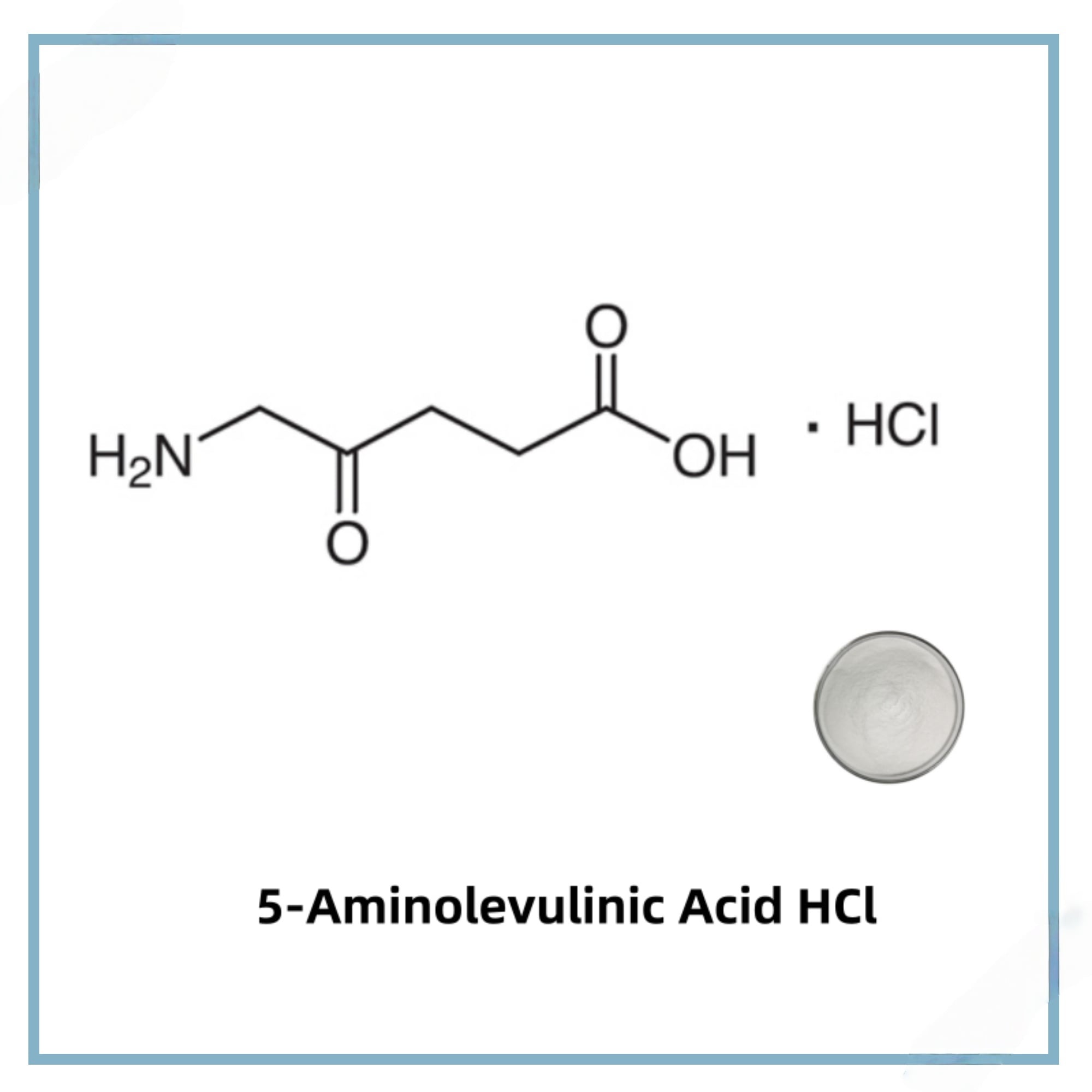
| Product Name | 5-Aminolevulinic Acid HCl |
| Synonyms | 5-ALA; Pentanoic acid, 5-amino-4-oxo-, hydrochloride; 5-Aminolevulinic acid hydrochloride |
| CAS Number | 5451-09-2 |
| Purity | ≥99% |
| EINECS Number | 226-679-5 |
| Molecular Formula | C₅H₁₀NO₃Cl |
| Molecular Weight | 167.59 g/mol |
| Appearance | White to Slightly Yellow Powder |
| Minimum Order Quantity | 1 KG |
| Packaging | 1kg/5kg Aluminum Foil Bag; 25kg/Drum; 25kg/Carton; Customized Packaging Available |
| Storage Conditions | Store in a Cool, Dry Place, Tightly Sealed, Away from Heat and Light |
| Payment Terms | T/T, L/C, D/A |
| Lead Time | Local Warehouse Stock Available, Delivery Within 1–3 Days |
| Place of Origin | China |
| Shipping Methods | DHL, FedEx, TNT, EMS, Air Freight, Sea Freight |
5-Aminolevulinic acid hydrochloride (5-ALA HCl) occurs naturally in living systems. It is a nitrogen-containing substance involved in heme formation in the human body.
1.5-ALA is often used with iron-containing ingredients. Sodium ferrous citrate is one example. Heme generation occurs in mitochondria. Effects related to glucose metabolism have also been reported in studies of 5-ALA. Better insulin sensitivity and higher cellular glucose uptake have been observed in related studies. 5-ALA is used in products related to blood glucose and glucose tolerance. It is also used by people following ketogenic diets, limiting sugar intake, or controlling body weight. Mitochondria are one of the sites where 5-ALA exerts its biological activity. Studies have observed effects related to aerobic endurance and oxidative stress.These functions are often associated with post-exercise recovery. Endogenous 5-ALA levels are lower in older individuals. For this reason, supplementation is often considered in products related to metabolic health. Observations involving older adults have included effects related to energy and immune function.
2.In cosmetics, 5-Aminolevulinic acid (5-ALA) has a molecular weight of less than 500 Da. Studies have reported penetration across the stratum corneum. Research has reported effects in dermal fibroblasts. Changes in collagen and hyaluronic acid production have also been observed. Applications related to dryness-associated wrinkles and photoaging are among the areas of interest. Unlike hyaluronic acid, which merely “attracts water” at the surface, 5-ALA boosts the skin’s endogenous moisture content by enhancing the metabolic activity of skin cells, earning it the title of “moisture amplifier.” It also helps cells with compromised barriers rapidly replenish energy and accelerates cell renewal, providing an excellent, gentle, and soothing effect for redness and sensitivity caused by seasonal changes.
1. By adopting high-cell-density fermentation of recombinant bacteria as an eco-friendly production pathway, we achieve superior stereoselectivity and eliminate toxic chemical reagents at the very source. Besides, its content is maintained at ≥99%, while single impurities and total impurities are kept at very low levels. In conclusion, our material is fully eco-friendly and complies with sustainable and carbon-neutral principles.
2.Through the operation of a GMP-level production management system, we have fully optimized the refined crystallization process, keeping heavy metals including lead, mercury and arsenic strictly controlled at ultra-trace levels per top international standards. Meanwhile, ultrapure water is used throughout production, and microbial count control far exceeds the industry average standards.
3.Our fermentation and purification processes have completed industrial scale-up, delivering stable, consistent monthly output in metric tons. While sustaining world-class product quality, we have substantially cut energy use and raw material costs.
4.Whether you need gram-sized R&D samples or ton-level bulk goods, we ship all orders within 7-14 working days to maintain reliable supply.
Q1: Is your 5-ALA hydrochloride produced by chemical synthesis or fermentation? What is the difference?
A: Enzymatic fermentation is the production method used for our 5-ALA hydrochloride. The process does not involve toxic organic solvents. No harmful chemical catalysts are used. High purity is one of the characteristics of this material. Chemical residue concerns are also reduced. The ingredient can be used in clean-label products. Cosmetics and nutrition products are two common application areas for this ingredient.
Q2: What are the main benefits of 5-ALA hydrochloride in premium skincare products?
A: 5-ALA hydrochloride is a small-molecule compound with a molecular weight below 500 Da. Research has documented its movement through the stratum corneum after topical application. Studies have reported effects on ATP generation and cell turnover. Changes in collagen and hyaluronic acid production have also been observed. These findings are related to improvements in wrinkle appearance. Moisture retention is another area of application. Increased hydration of the skin has been reported. The ingredient is present in some products designed for sensitive skin. Use in products related to skin redness has also been reported.
Q3: How is 5-ALA hydrochloride used in dietary supplements? What are its key health benefits?
A: 5-ALA hydrochloride may be used together with iron-containing materials. Sodium Ferrous Citrate is one example. The production of heme occurs in mitochondria. Iron is involved in this biological process.
Q4: Why does color variation sometimes occur in liquid formulations containing 5-ALA?
A: Crystalline 5-ALA hydrochloride is generally stable. After dissolution, stability may be influenced by pH conditions and certain metal ions.
For cosmetic formulations:
• pH 4.0–6.5 is recommended.
• EDTA-2Na or similar chelating agents can be considered when free metal ions are present.
Formulation information and stability data are available upon request.
Shandong Fulibai specializes in providing high-quality raw materials for the nutritional and cosmetic industries.
Floor 13, Block 1, No. 6888, Jiankang East Street, Weifang High-tech Zone, Shandong Province, China.
Copyright © 2026 SHANDONG FULIBAI CHEM CO.,LIMITED. All rights reserved. Privacy Policy
 EN
EN